A headcount freeze does not stop the work. It changes where the invoice lands.
A headcount freeze can move work into contractors, SOW, outsourcing and AI while the cost disappears across separate budgets.
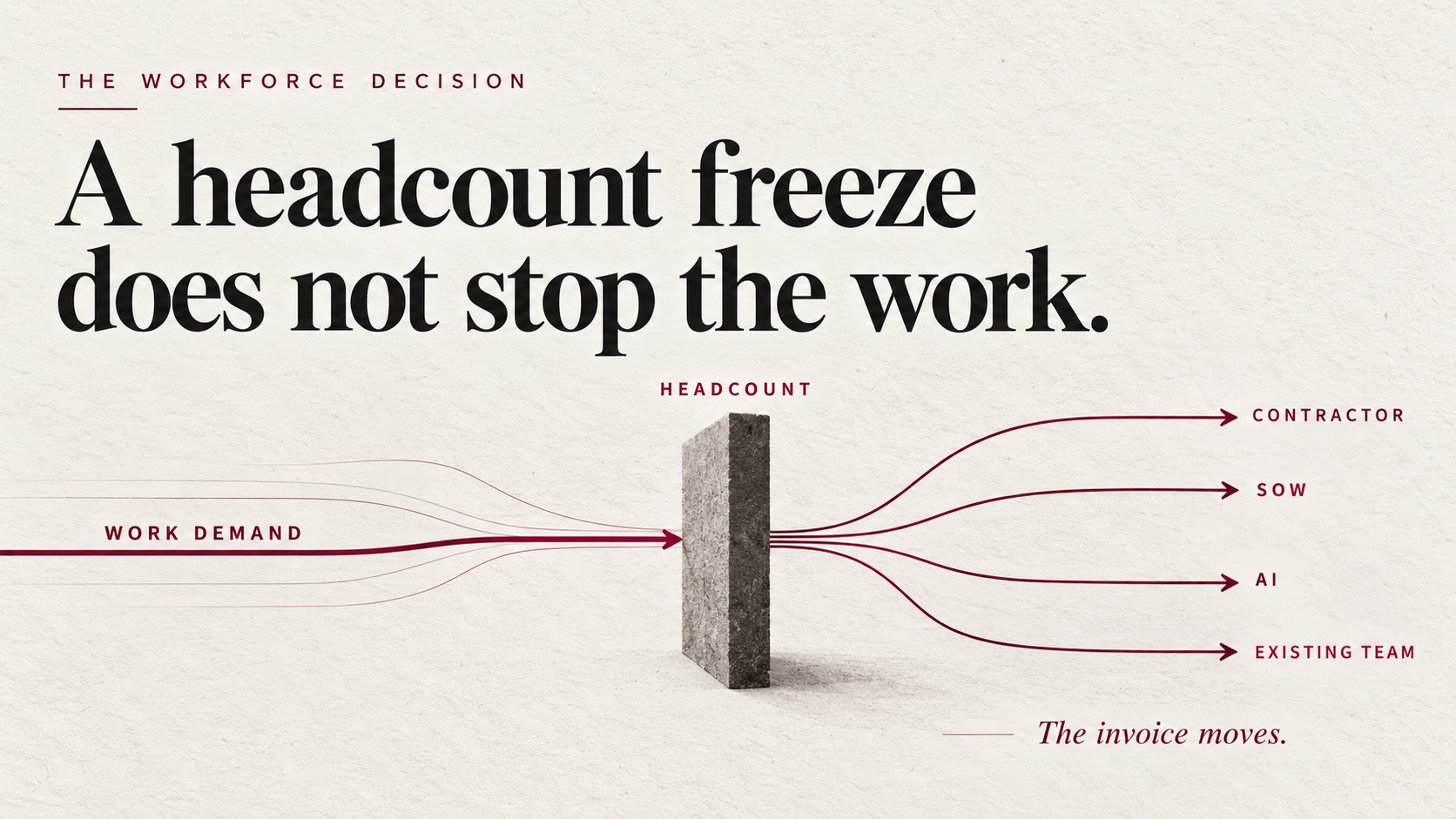
A regional function asks for five employee roles. Finance rejects the request. The headcount plan stays flat.
The work does not disappear.
Two contractors arrive under an operating budget. A consulting firm takes part of the scope through an SOW. One team buys an AI tool to handle the repeatable reporting. Managers spread the rest across existing employees.
Six months later, the headcount report shows that the control worked. The organisation did not add five employees.
It may now be paying for the same work through four different budgets.
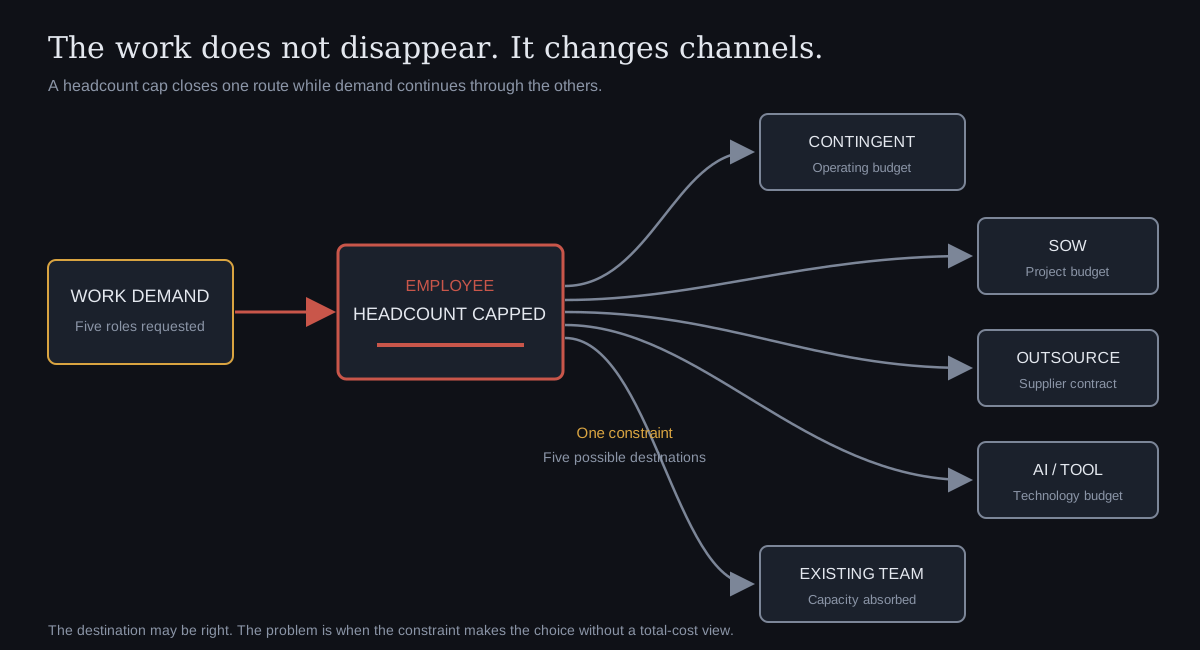
This is the Headcount Cap Displacement loop from my contingent workforce causal model. The cap controls one category. Demand moves through the channels that remain open.
A cap controls headcount. It does not control demand.
A headcount freeze can be necessary. Revenue may have slowed. Productivity may need to improve. A business may have hired ahead of demand. Finance should be able to stop permanent cost from growing without evidence.
The mistake is treating the rejected request as proof that the cost was avoided.
Some work will stop. Some will be absorbed. Some should be redesigned. But work tied to a customer deadline, regulatory obligation or operating dependency usually finds another route.
Managers learn those routes quickly. If employee headcount is closed, they ask for a contractor. When contingent approvals tighten, the request becomes an SOW. If Procurement challenges the SOW, the work moves to an existing outsourcing contract. A technology budget may fund an AI tool because it does not appear in the workforce plan at all.
Each move can be reasonable. The failure is allowing the restriction to choose the channel without comparing the options.
Every function can report success while the total gets worse
HR reports controlled employee headcount. The contingent workforce programme reports approved contractors. Procurement reports negotiated SOW savings. IT reports automation adoption. Business leaders report that delivery continued.
None of those reports is false.
They answer different questions, across different ledgers, with different owners. They do not show whether the organisation reduced the work, changed how it was done, or moved its cost somewhere less visible.
That matters because the replacement channel changes more than the invoice.
A contractor may provide useful flexibility, but an ongoing role can remain at a premium for years. An SOW may transfer delivery responsibility, but a vague deliverable can hide staff augmentation behind supplier margin. Outsourcing can add scale, but it can also create dependency and future switching cost. AI can remove repeatable tasks, but the organisation still needs to decide who owns the output, supervises exceptions and redesigns the remaining human work.
The question is not whether one channel is good or bad. It is whether the channel was chosen because it fits the work.
Trace the work after the rejection
Most organisations record the headcount request and the rejection. They rarely follow the work.
Take ten employee roles rejected in the last quarter. Revisit them after ninety days.
Did the work stop? Did an existing employee absorb it? Was a contractor engaged? Did a supplier receive an SOW? Was the work moved offshore or into an outsourcing contract? Did technology remove the need, or did the tool become another cost sitting beside the unchanged work?
Then compare what leadership believed it had avoided with what the organisation is now paying. Include ramp time, supplier margin, manager effort, rework and the cost of delay. A lower employee count can coexist with higher total workforce cost.
The result will not always prove that the original employee request was right. It may show that the role was poorly designed, the work should have stopped, or automation was the better answer. That is useful. The purpose is to replace assumed savings with evidence about what happened to the work.
Use the constraint to improve the decision
A headcount control becomes more useful when it forces a work decision instead of a budget detour.
Before rejecting or approving the request, ask what outcome is needed, which tasks are continuing, what capability the organisation must retain, how long the demand will last and which channel offers the best total cost and risk.
Then name one owner for the result across channels. Without that owner, HR closes the employee request and the rest of the organisation buys the answer in pieces.
The question for the leadership team: When we reject employee headcount, can we show whether the work stopped, moved to another workforce channel, or became an AI or technology cost?
If leadership can see only the rejected roles, the control is measuring the door that closed. It is not measuring where the work went.
I’m Vinos Samuel. I help APAC leaders in HR, Procurement and Finance redesign contingent workforce programmes that have outgrown their operating model. If headcount controls are moving work into budgets nobody sees together, send me a note on LinkedIn.