MSP vs In-House CW Program in APAC: When to Outsource Governance
A practical framework for APAC workforce leaders on when to outsource contingent workforce governance to an MSP, and when to build it in-house.
A new VP of People joins in the second quarter. In her first workforce review, she asks a simple question: why does this company run contingent labor through an MSP in six markets, and manage it directly in two?
Nobody in the room has a real answer. The MSP relationship predates everyone at the table. The two in-house markets are in-house because a regional lead fought to keep them years ago, for reasons nobody quite remembers. Nobody chose this arrangement. It accumulated, one market and one procurement cycle at a time.
Six months later, a contractor in one of the "in-house" markets is reclassified as an employee following a labor complaint. The reclassification doesn't happen because anyone misjudged the legal test. It happens because nobody owned that test closely enough, in that specific market, to notice how the working relationship had drifted from what the contract said. The program had governance. It just didn't have it everywhere the program actually operated.
This is not a rare story. It is the default failure mode for how most organizations end up choosing between an MSP and an in-house contingent workforce program — which is to say, they mostly don't choose. They inherit, and the choice quietly stops being revisited.
Governance Is the Real Decision, Not "MSP or Not"
The MSP-vs-in-house question gets framed as a vendor decision. It isn't. It's a governance decision.
Governance is the set of ongoing calls a program has to make: how work gets classified as employee or non-employee, how rates get benchmarked, how vendors get monitored, how contracts get renewed or exited, and how all of that gets reported when someone in Legal or Finance asks a question.
An MSP is one way to staff that governance layer. Building it in-house is another. Both can work well. Both can also fail quietly if the organization picks one out of habit rather than fit — which, per the story above, is exactly how most programs end up structured.
The APAC Complication
This decision is harder in APAC than almost anywhere else, for one structural reason: worker classification and labor law are not standardized across markets. What qualifies as an independent contractor in Singapore is not the same test used in India, Australia, or Japan. Non-Employee Navigator's own regulation library covers 14 APAC markets, and no two are identical.
That fragmentation is the single biggest driver of MSP demand in the region. Building deep classification expertise in one market is achievable in-house, with the right people and enough repetition. Building and maintaining that same depth across ten markets, each with its own regulatory drift, its own enforcement posture, and its own definition of what "control" and "independence" actually mean, is a different scale of problem entirely. Few in-house teams are resourced to do it well in more than two or three markets at once.
I've sat on both sides of this. Building a contingent talent COE from scratch across APAC — covering 1,000+ contractors and nine-figure spend — the pattern that kept showing up wasn't "we picked the wrong MSP." It was that governance depth lived in one or two markets, and everywhere else the program ran on hope plus a vendor deck. Classification calls that were careful in Singapore got rubber-stamped in markets where nobody on the buyer side could name the local test. That's when MSP coverage stops being a cost line and starts being the only thing keeping the program honest.
What Good Governance Requires, Regardless of Model
Before choosing MSP, in-house, or hybrid, it's worth being honest about what any of those models actually need to deliver. An organization that can't answer these for its own program doesn't yet have a governance model — it has a vendor relationship, or a headcount line, standing in for one.
- Who can tell you, today, why a specific worker in a specific market is classified as a contractor and not an employee — and how recently that classification was actually reviewed, not just filed?
- If a vendor underperforms in your smallest market, does anyone notice before the contract renews itself, or only after something breaks?
- Could you produce a current, accurate spend and headcount picture across every market this week — not by end of quarter, this week — if Legal or the board asked for it?
If the honest answer to any of those is "not really," the gap usually isn't the vendor model. It's that governance depth doesn't reach as far as the program does.
Signals That Favor an MSP
None of these alone is decisive, but they tend to cluster together in programs where MSP coverage is doing real work, not just adding a management fee:
- The program spans multiple APAC markets with meaningfully different labor law regimes. Coverage matters more than customization once you're past two or three jurisdictions.
- Internal HR and procurement bandwidth is thin relative to program volume. A stretched internal team defaults to the fastest path, not the most careful one, and classification is the first thing to slip.
- The program is early-stage or scaling quickly. Standing infrastructure beats building from zero in every new market you enter.
- Leadership wants one point of accountability for compliance reporting. A single MSP relationship is easier to audit than five internal owners with five different levels of rigor.
Signals That Favor In-House
The reverse pattern shows up just as clearly, usually in the one or two markets where a program has real history:
- The program is concentrated in one or two markets the organization already understands well. Depth beats breadth when there isn't much breadth to manage.
- Vendor relationships and rate data are strategic enough that direct ownership creates real advantage. Some markets are core to the business in a way that justifies owning the relationship, not renting it.
- There's sufficient volume to justify dedicated internal headcount without idle capacity. Below a certain volume, in-house governance is a part-time job stretched across a full-time role.
- The organization wants governance tightly integrated with internal HR systems and workforce planning — not sitting one layer removed, translated through a vendor's own reporting cadence.
The Mistake: Treating It as Permanent
The most common error isn't picking the wrong model. It's treating the choice as a one-time decision instead of a maturity stage.
A program that starts on an MSP because it needs fast multi-market coverage can genuinely outgrow that need in its core markets, while still needing MSP support in the markets where volume never justifies building internal expertise. The reverse also happens: an in-house program that scoped itself for two markets and then expanded to six without revisiting the governance model, quietly accumulating risk in the markets nobody has real depth in — exactly the pattern in the opening story.
The better question isn't "MSP or in-house." It's "which markets, right now, justify which model — and what would have to change for that answer to shift."
Back to the VP of People from the opening. The honest fix in her situation was never "move every market onto the MSP" or "bring everything in-house to be safe." It was going market by market and asking whether the current model actually matched the program's depth there — then doing the less comfortable work of saying so out loud, instead of leaving six markets and two markets to keep drifting along on inherited logic nobody had checked in years.
The APAC Default
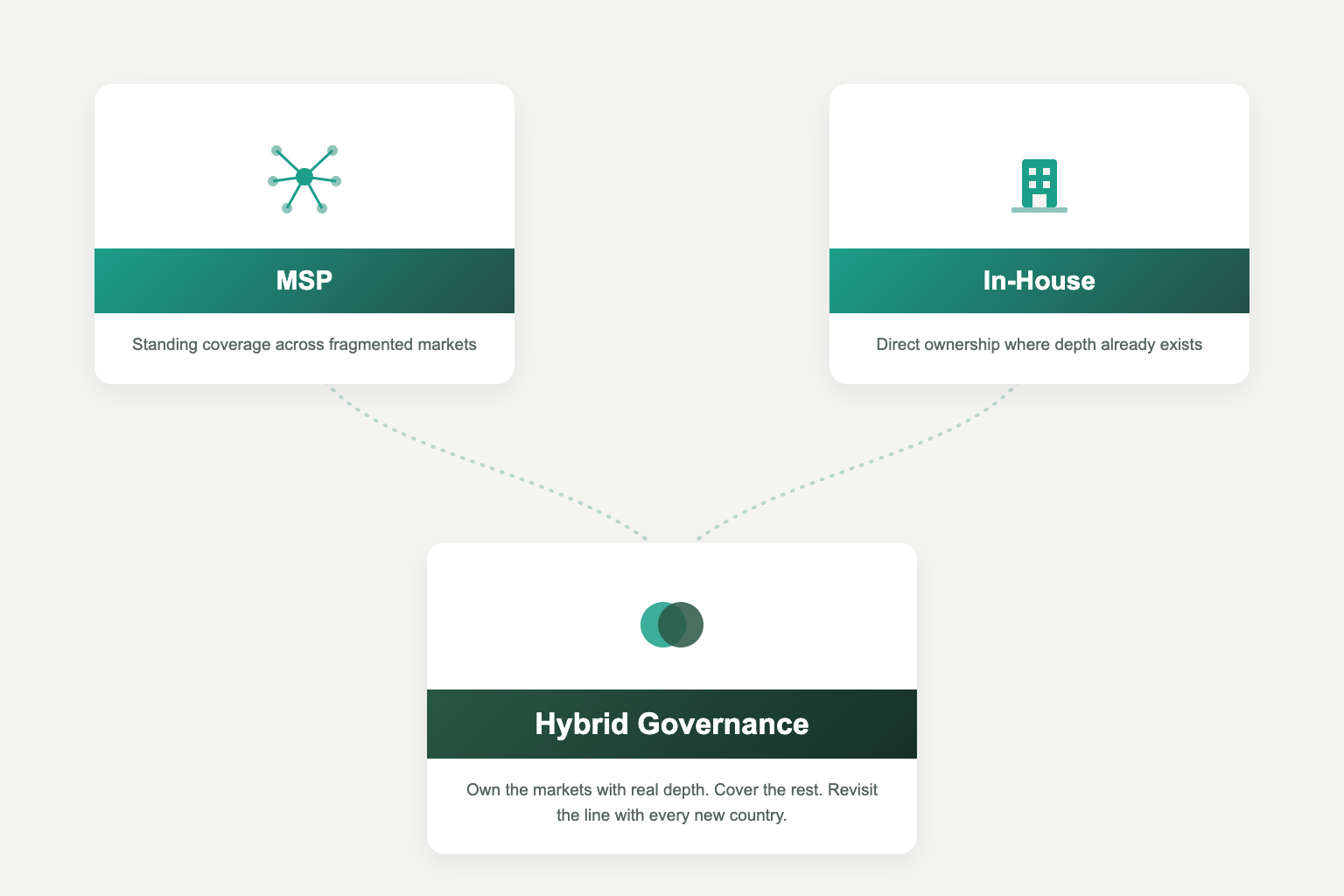
Hybrid isn't a compromise. It's the APAC default once you stop treating governance as a one-time vendor RFP. Pick the markets you'll own deeply. Cover the rest. Revisit the line every time you add a country — not every three years when Legal asks why something broke.
Frequently Asked Questions
What does "governance" actually mean in a contingent workforce program?
It means the ongoing decisions and controls around how non-employee work gets classified, sourced, priced, onboarded, monitored, and exited — worker classification calls, rate benchmarking, vendor performance, contract renewals, and compliance reporting across every jurisdiction the program touches. It is not the same as simply "having contractors." A program can have hundreds of contractors and no real governance at all.
When does it make sense to bring CW governance in-house?
Once program volume and market count are stable enough to justify dedicated headcount, and once the organization has built internal muscle in worker classification and vendor management specific to contingent labor (not just full-time hiring). In-house makes the most sense when the program is concentrated in a small number of markets you already understand deeply.
Does using an MSP eliminate compliance risk?
No. An MSP reduces operational and coverage risk by giving you standing infrastructure across markets, but the organization is still accountable for classification decisions and program outcomes. A good MSP surfaces risk faster and more consistently; it does not transfer legal accountability away from the buyer.
Can a program run a hybrid model, part MSP and part in-house?
Yes, and in practice most mature APAC programs end up here. A common pattern is in-house ownership in one or two core markets with deep internal expertise, and MSP coverage for the remaining, more fragmented markets where building dedicated internal capability wouldn't be worth the investment.
How long does a transition from MSP to in-house typically take?
There's no reliable fixed timeline — it depends on program complexity, number of markets, and how much institutional knowledge currently sits with the MSP rather than the organization. The honest planning assumption is that it takes longer than leaders expect, because the transition includes rebuilding vendor relationships and compliance monitoring that the MSP had already absorbed.