The budget chooses the worker before the business defines the work
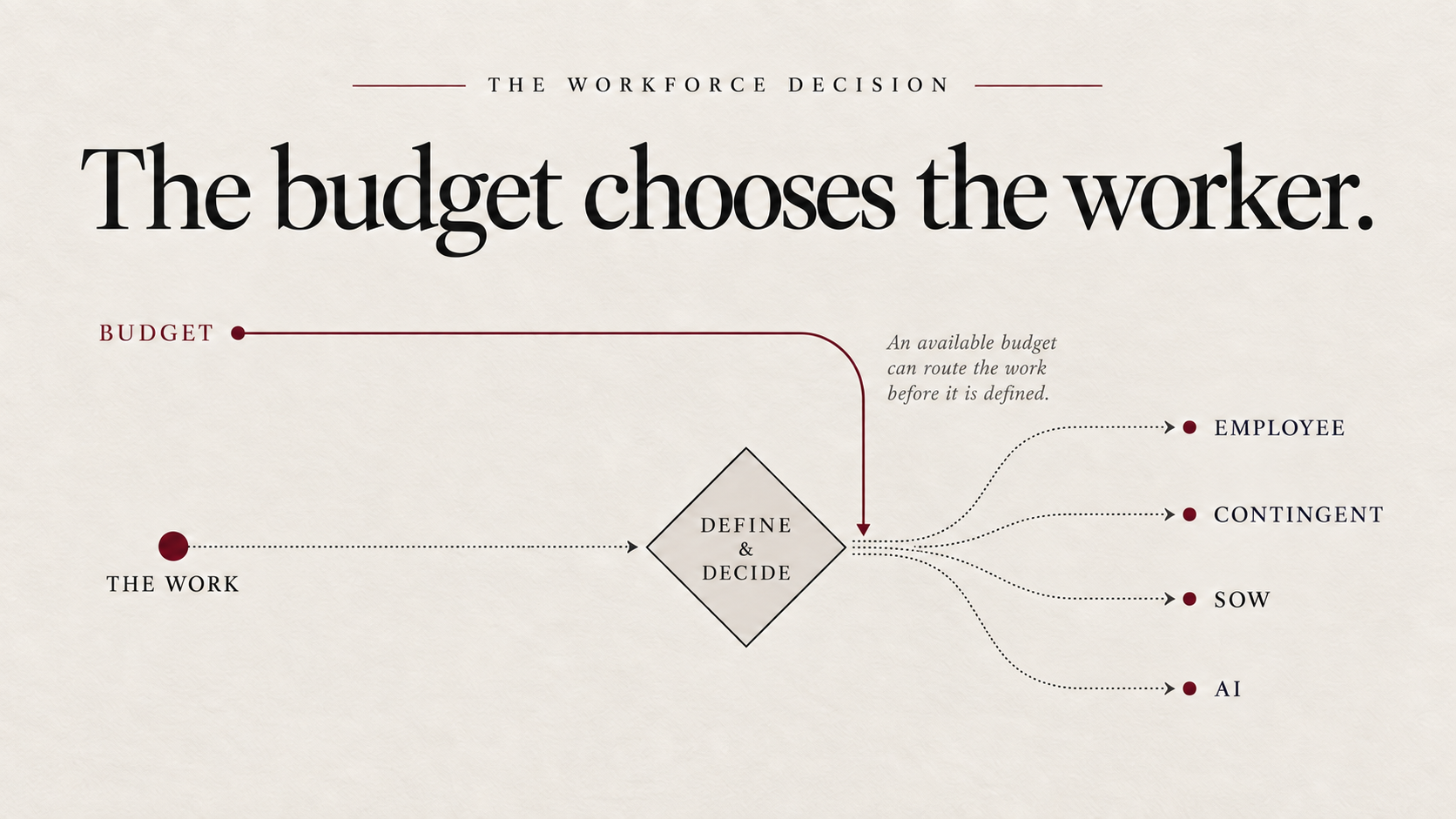
The function that receives a work request often decides whether it becomes a hire, a contractor, an SOW, or automation — not the work itself.
A regional leader needs more reporting capacity across APAC.
The work could become an employee role. It could go to a contractor for twelve months. A supplier could take it on as a project. Some of it may be repeatable enough to automate.
The route often depends on where the request lands.
Send it to TA and it becomes a job description. Send it to Procurement and it becomes an SOW. Send it to IT and it becomes an automation opportunity. If employee headcount is closed but project budget is available, the answer may be settled before any of those teams see it.
The work has not changed. Its label and budget have.
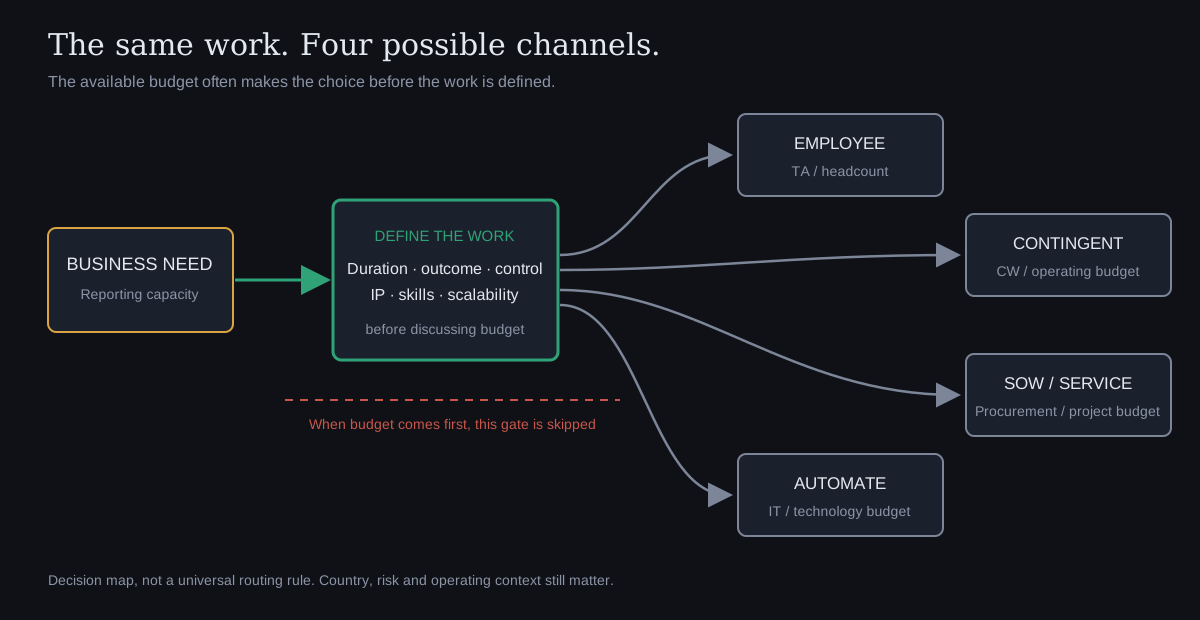
This is a focused view of the first three stages in my workforce value-flow model: define the need, classify the work, then choose the channel. These stages cost little and set most of what follows.
A budget is not a work-design method
Budgets answer a necessary question: who can pay?
They do not tell us whether the need is ongoing, whether the organisation should own the capability, how much direction the worker will receive, whether the output can be specified, or how much delay will cost.
Those questions should decide the channel.
In practice, each function sees the part it can act on. TA knows how to hire a role. A contingent workforce programme knows how to engage temporary capacity. Procurement knows how to contract a supplier. IT knows how to assess a tool. Managers learn which route will clear approval fastest.
Over time, the fastest route becomes the operating model.
An eighteen-month business-as-usual need can remain contingent because employee headcount is unavailable. Capacity can be written as an SOW even when nobody can state the deliverable or acceptance criteria. A software purchase can remove tasks from a role without HR seeing that the work has moved. Each transaction may pass its own approval. The combined workforce decision remains invisible.
Good execution cannot repair a poor route
Once the channel is selected, attention moves downstream.
TA improves the job description. The MSP searches for candidates. Procurement negotiates the SOW. Legal checks the classification. IT reviews the vendor. These teams can execute the route well. They cannot determine whether it was the right route if the work was never defined first.
This is why organisations can report success in every function and still pay too much for the wrong arrangement.
The employee vacancy is filled. The contractor starts on time. The SOW is signed. The AI tool goes live. Yet the organisation may still have placed permanent work on temporary paper, bought labour as an outcome, or automated a task without redesigning the role around it.
The problem is upstream of sourcing. It sits at the point where a business need becomes a channel request.
Put one decision before the budgets divide
A useful intake does not begin by asking whether the manager wants an employee, contractor or supplier. It asks enough about the work to rule channels in or out.
What outcome is needed? Is the need continuing or time limited? Does the organisation need to retain the capability or intellectual property? Will the business direct the work day to day? Can a supplier own a measurable deliverable? Is the work stable enough to automate? What is one week of delay worth?
The answers will not produce a perfect formula. They give HR, TA, Procurement, Finance and IT the same object to discuss before each function translates it into its own language.
The owner of that decision also matters. If nobody has authority across channels, intake becomes a referral service. It sends the request to the team that the manager selected and records the result. A channel-choice gate must be able to challenge that selection while the decision is still cheap to change.
Start with ten recent requests. Ignore the channel that was chosen and describe the work again from the beginning. Then compare the work with the route, duration, cost and result. The disagreements will show where budget availability has been standing in for workforce strategy.
The question for the leadership team: Before we approve the next employee hire, contractor, SOW or AI investment, can we explain why that channel fits the work, rather than only which budget can pay for it?
If the answer depends on where the request was submitted, the organisation does not yet have one workforce strategy. It has several purchasing routes.
I’m Vinos Samuel. I help APAC leaders in HR, Procurement and Finance redesign contingent workforce programmes that have outgrown their operating model. If channel decisions in your organisation depend more on budget access than the work itself, send me a note on LinkedIn.