The MSP of the future will manage exceptions, not transactions.
As AI agents absorb routine programme administration, MSP value moves toward exceptions, judgment and operating-model improvement.
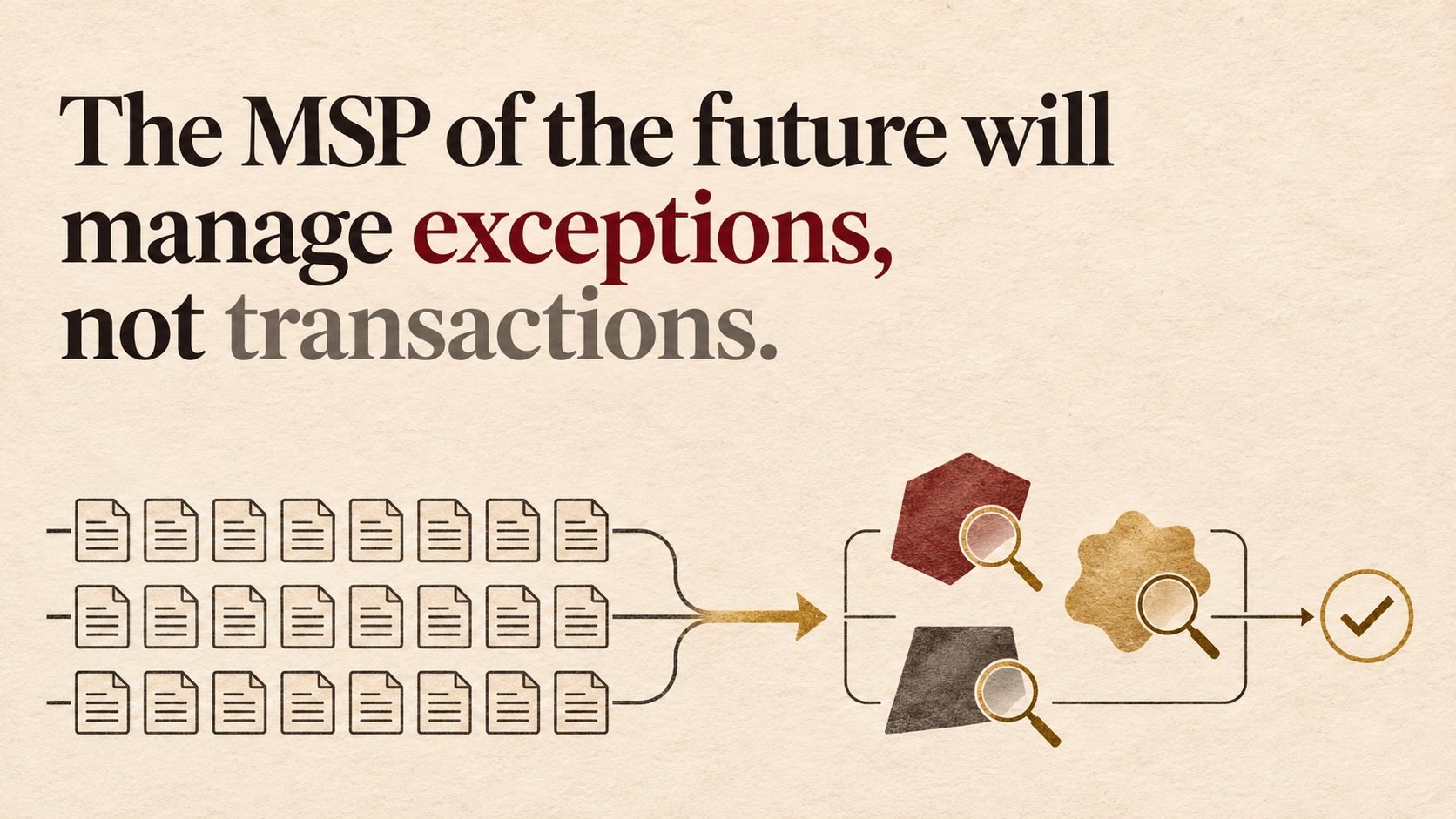
A manager raises a contingent-worker request. The MSP checks the details, confirms the rate, selects the supplier route, releases the requisition, monitors submissions, chases approvals and moves the worker through onboarding.
That sequence has defined much of the visible work inside an MSP programme.
It is also the work AI agents are beginning to enter.
Workday VNDLY has launched a Contingent Sourcing Agent that grades applicants and recommends previous talent for new roles. Workday describes the direction clearly: the VMS is moving from a system of record to a system of action.
Beeline has taken another route. Its Model Context Protocol capability allows approved AI assistants and agents to use VMS data and actions through existing permissions and workflow controls. The early capabilities focus on requests, candidates, assignments, SOWs, projects and approvals, with more transactional actions planned.
These are early products. The direction is already visible.
When the VMS can retrieve information, apply programme rules and move routine work forward, the MSP operating model has to change with it.
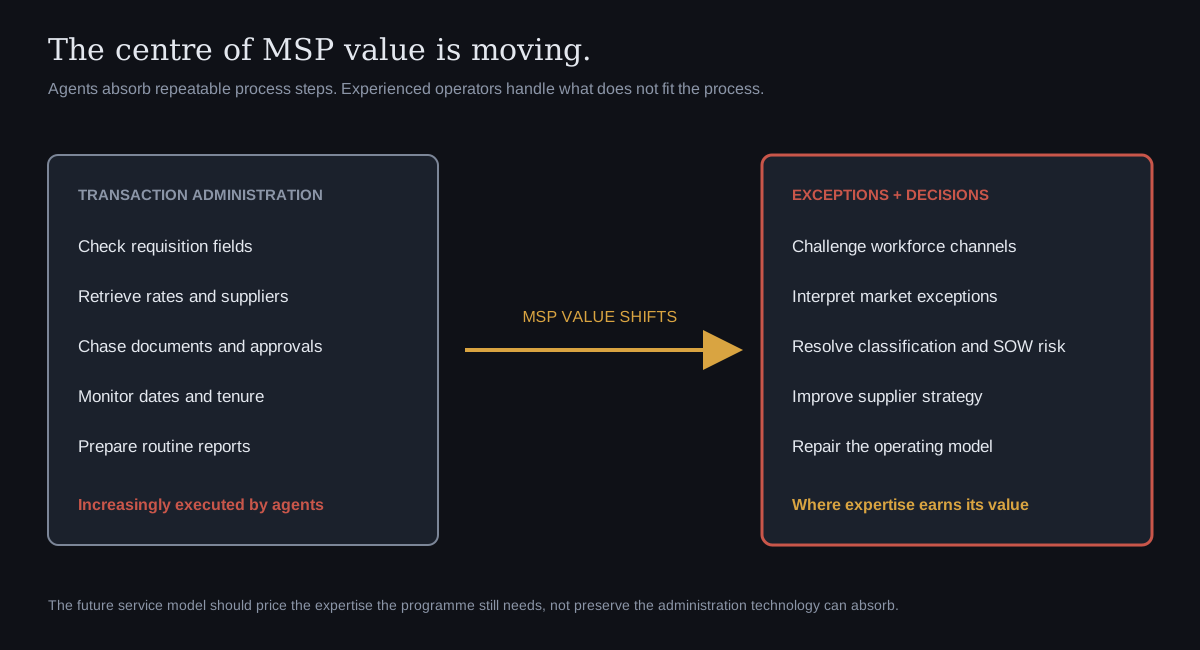
Much of the current model pays people to move the process
MSPs brought control to fragmented contingent hiring. They created one route for managers, standardised supplier access, enforced rate cards, tracked approvals and gave buyers a clearer view of spend and workers.
That work still matters. But many programmes deliver it through people performing repeatable steps around the VMS.
A coordinator checks whether a request is complete. A recruiter compares submissions. An operations team follows up on documents. A programme manager identifies an extension approaching its tenure limit. Someone compiles the same weekly report and explains why an approval is late.
The value is often described as programme management. A large part of the effort is transaction movement.
Agent-enabled VMS platforms will not remove all of this work at once. They will remove it workflow by workflow.
Start with the work an agent can execute
An agent does not need to replace the programme team to change its economics.
It only needs to absorb enough repeated work:
- Check a requisition against required fields and programme policy.
- Retrieve the correct rate card, supplier list and approval route.
- Grade or summarise candidate submissions for human review.
- Find known workers who match a new requirement.
- Monitor documents, approvals, tenure and assignment dates.
- Prepare extensions, offboarding actions and routine reports.
- Prompt the right person when a transaction stops moving.
Each task looks small. Together, they account for a meaningful share of programme administration.
The advantage is not simply lower operating cost. Managers get answers earlier. Suppliers receive clearer requirements. Controls appear before the transaction has gone too far. Programme teams spend less time searching, copying, chasing and updating.
But this creates an uncomfortable question for providers and buyers: if the technology performs more of the process, where does the MSP earn its value?
The hard work moves to the exceptions
Routine transactions follow the programme design. Exceptions reveal whether that design works.
A hiring manager wants to exceed the rate card because the skill is scarce in Tokyo. A six-month role has been extended for three years. An SOW names individuals, bills by the hour and is managed like staff augmentation. A global policy conflicts with a local classification rule. The fastest supplier is producing weak retention. The lowest-cost channel creates more supervision and rework.
An agent can surface these conditions. It can retrieve evidence, compare the transaction with policy and recommend the next action.
Someone still has to understand the business need, challenge the default route and decide whether the rule or the request should change.
That is where experienced MSP and contingent workforce professionals become more valuable, not less.
Five capabilities replace transaction administration as the centre of value
Exception design. Define which conditions can proceed automatically, which require review and who has authority to decide.
Workforce-channel advice. Help managers decide whether the need calls for an employee, contractor, independent specialist, SOW, managed service or automation.
Supplier-market judgment. Understand where capability exists, when the rate card is no longer credible and which suppliers produce durable outcomes rather than quick submissions.
Risk interpretation. Apply classification, tenure, co-employment, data and SOW principles to cases that do not fit a clean rule.
Operating-model improvement. Use the pattern of exceptions to repair policies, workflows, commercial terms and decision rights.
Everest Group describes the same market movement as a shift from programme administration toward external-workforce orchestration, accelerated by AI, automation and workforce intelligence.
Orchestration becomes real when the MSP improves decisions across channels. It is not a new label for the same administrative service.
The commercial model will come under pressure too
Many MSP arrangements were designed around spend, requisition volume, programme headcount and service levels for human-operated workflows.
If agent-enabled platforms reduce the effort required for each transaction, buyers will ask why the old delivery structure and fee logic should remain unchanged. Providers may respond by adding AI while protecting the existing model. That creates automation without a clear transfer of value.
A better discussion starts with outcomes.
What should become faster? Which programme costs should fall? Which risks should be found earlier? Which decisions should improve? What expertise should remain available when the standard process is wrong?
The answer may combine a smaller transaction layer with higher-value advisory, specialist exception support and clearer outcome measures.
APAC makes the exception layer more important
APAC programmes rarely operate as one consistent market. Classification, tenure, tax, licensing, language, supplier capability and management practice vary by country.
Automation can apply standard rules more consistently. It can also push an unsuitable global rule through the region faster.
The strongest APAC MSPs will encode what can be standardised, maintain current local knowledge and know when the country context requires a different answer. Their advantage will not be the number of people available to administer the process. It will be the quality and speed of judgment when the process reaches its limit.
Redesign the service before renewing it
Before the next MSP renewal, take one high-volume workflow and separate its steps into three groups:
- Actions the VMS or an agent can execute.
- Decisions that need defined human approval.
- Exceptions that need programme, market or risk expertise.
Then examine the staffing model, service levels and fees against that future workflow.
Do not pay a premium for people to perform work the platform is about to absorb. Do not remove the expertise needed when the automated process meets a real business exception.
The question for the leadership team: If AI removes much of the administration from your contingent workforce programme, what are you actually paying the MSP to do?
The MSP is not disappearing. Its most defensible value is moving away from the transaction and toward the decisions the transaction cannot make on its own.
I’m Vinos Samuel. I help APAC leaders in HR, Procurement and Finance redesign contingent workforce programmes that have outgrown their operating model. If your MSP model still prices yesterday’s administration while the technology moves toward agentic execution, send me a note on LinkedIn.