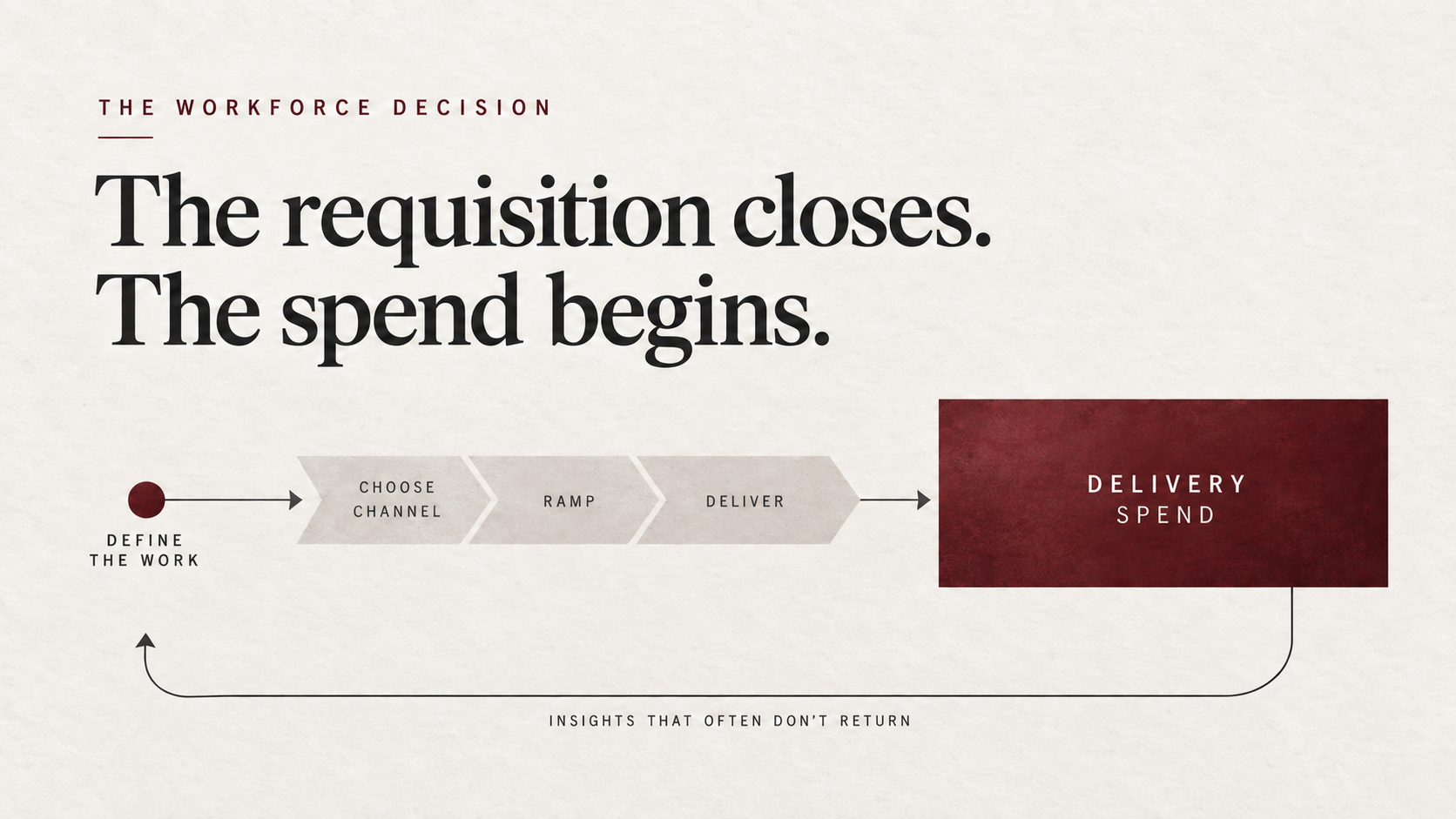
The requisition closes. The spend begins.
A project budget approves a contingent hire in six weeks — but budget access answers a finance question, not what the work actually needs.
A regional leader needs a data analyst for a new APAC reporting programme. The work must start in six weeks. Employee headcount is frozen, but a project budget is open. The request becomes a twelve-month contractor requisition.
That may be the right choice. Or it may be an ongoing role that belongs in the workforce plan. It may be a defined project a supplier could deliver. Some reporting tasks may no longer need a person at all. None of those possibilities can be settled by asking which budget has room.
The analyst starts. The requisition closes. TA records the fill, Procurement records a compliant contract, and Finance records the monthly invoice. Each function has finished its part. The organisation has barely begun paying for the decision.
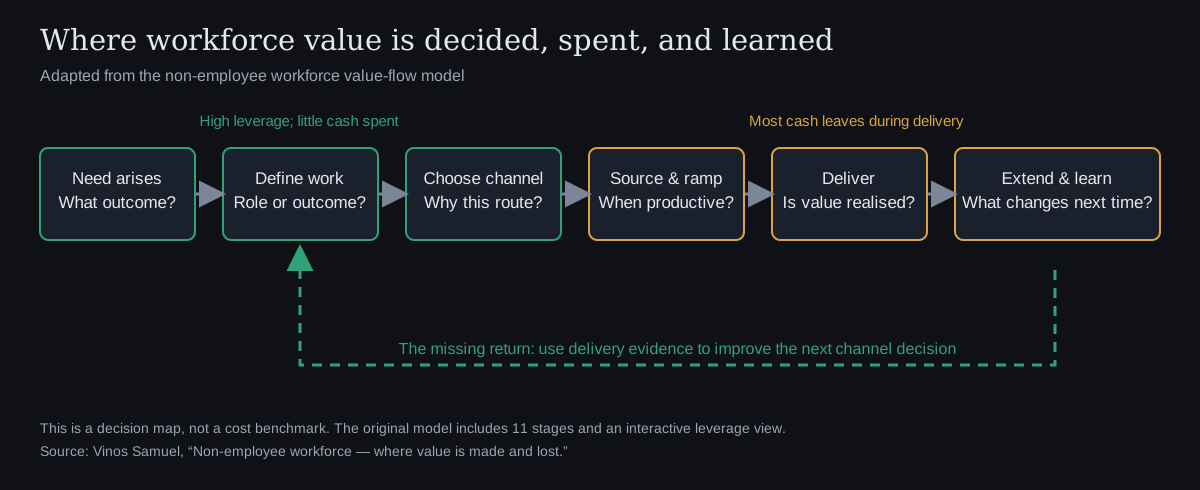
This is a condensed view, adapted from Vinos Samuel’s workforce value-flow model. The full model follows eleven stages and shows where leverage, attention and cash sit. The diagram is a decision map, not a cost benchmark.
The decision that sets the rest
The first useful question is not “How fast can we fill this?” It is “What work needs to get done, for how long, and what will tell us it worked?”
That answer shapes the channel. A continuing role with daily direction points towards an employee decision. A time-limited capacity gap may suit a contingent worker. A measurable deliverable may suit an SOW. A repeatable task may be redesigned or partly automated. The country, level of control, skills needed and risk still matter. There is no universal routing rule.
In the example, the project budget answers a finance question. It does not answer the work question. Yet once the contractor route is approved, every later function must operate inside it. Sourcing can find a strong analyst. Legal can improve the terms. Neither can recover a channel decision that was never made on the merits of the work.
Where the money and value actually move
Most programme attention sits before the start date: approvals, submissions, interviews, rate cards and checks. Those activities matter, but the long delivery period is where the organisation pays for the work and finds out whether the choice was sound.
The rate begins on day one. Productivity does not. The analyst needs access, context and someone who can explain the reporting system. If that takes weeks, the organisation buys ramp time before it buys useful output. If the assignment later extends by default, it may keep paying a premium for work that has become permanent. If it ends on a tenure rule, the next person may have to learn the same system again.
These costs rarely appear in a fill-time report. Nor does the value the analyst created. The invoice tells Finance what was paid; it does not tell HR or TA whether this was the right way to get the work done.
The flow diagram makes the imbalance visible. Early stages have the power to change the whole engagement. Delivery carries most of the cash. The last stage—learning—should send evidence back to the next work-definition and channel decision. In many programmes, that return path is missing.
What a better cycle would look like
This does not require a new dashboard first. Take one recent engagement and ask the business owner, TA, the contingent workforce lead, Procurement and Finance to reconstruct it together.
What outcome was requested? Why was this channel chosen? How long did it take from need to useful output? What was paid during ramp and delivery? Did the work change? What would the team choose if the same need appeared tomorrow?
The aim is not to prove that contractors cost too much or that employee hiring is always better. It is to give the next decision an honest reference point. When a programme can show where the work went, when it became productive and what value it delivered, channel choice stops being a contest between budget lines.
The question for the leadership team: Can we name one workforce-channel decision that evidence from a completed engagement has changed?
If the answer is no, the programme may be reporting activity without learning from the work it pays for.
I’m Vinos Samuel. I help APAC leaders in HR, Procurement and Finance redesign contingent workforce programmes that have outgrown their operating model. If this question is showing up in your organisation, send me a note on LinkedIn.