The Three-Lane Workforce
For two years I described the workforce as three lanes: employees, contingent, and digital workers. The practitioner world just caught up.
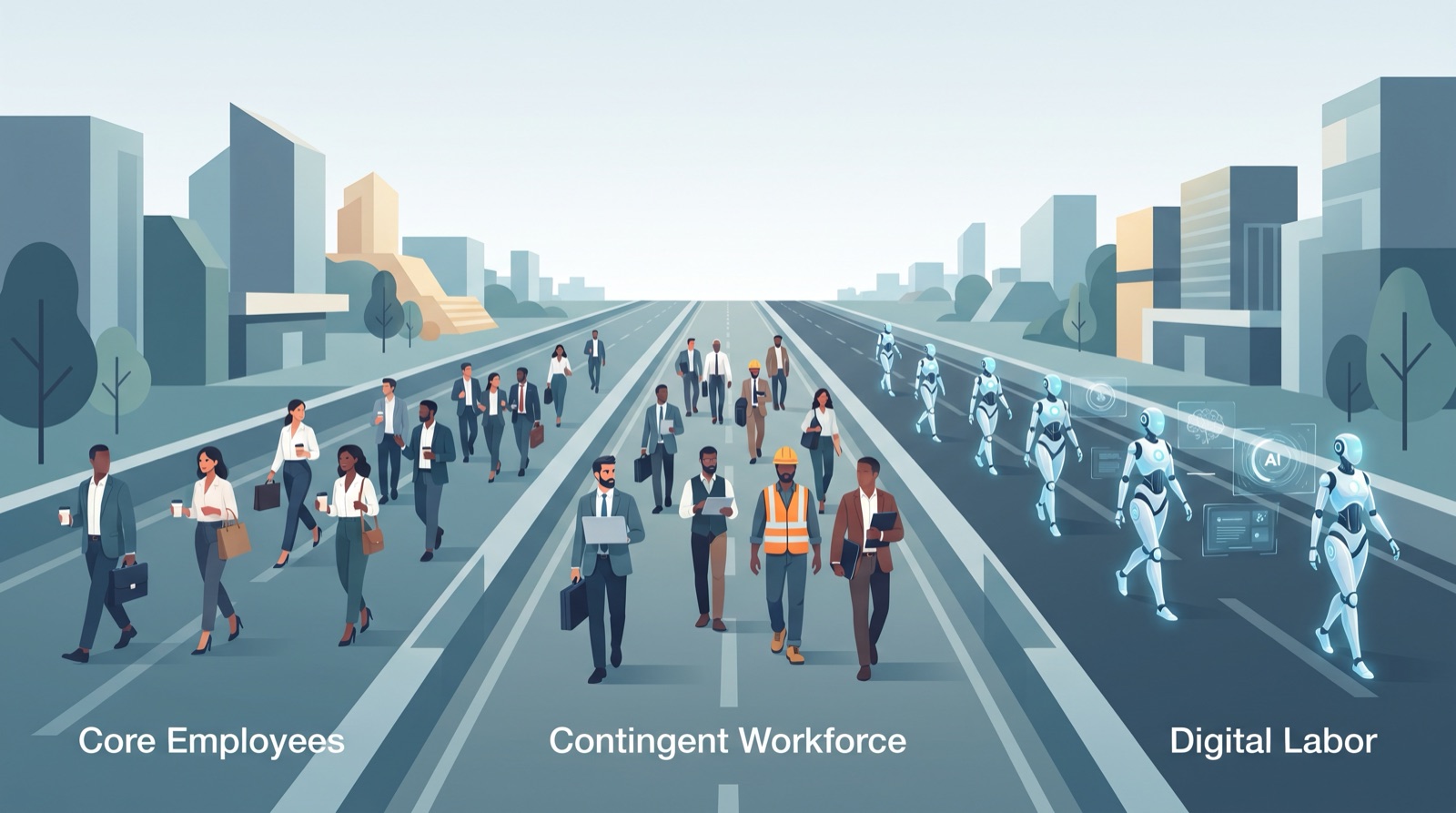
For a couple of years now, when someone at a conference or dinner asks what I actually do, I've described the workforce as three lanes.
Lane one is your employees. Permanent, on payroll, the people the organisation means when it says "us".
Lane two is contingent. Contractors, temps, SOW teams, agency staff. The flexible layer most companies have leaned on for decades and still govern badly.
Lane three used to get a polite nod and a change of subject. Digital workers. Software that doesn't just run a process but does the work... reads the ticket, drafts the reply, reconciles the invoice, chases the renewal. Two years ago that was a slide. Now it's an AI agent sitting inside a workflow with a task, a login, and a deadline.
In July 2026, Staffing Industry Analysts wrote about companies moving to a hybrid staffing model: employees, contingent workers, and digital workers, managed as one. The practitioner version caught up to the party pitch.
I'm not writing this to say I called it. I'm writing it because the moment an idea stops being a metaphor and becomes an operating model, the hard part begins.
Adding a lane changes the whole road
Here's the mistake I see already. Companies treat the third lane as an add-on. Buy some agents, plug them into a few workflows, count the saved hours. Additive thinking.
It isn't additive. The third lane changes how you have to run the first two.
Start with the oldest question in this field: employee or contractor. For thirty years that was the classification decision, and getting it wrong cost you back-taxes and a tribunal. That question now sits one level down. The first question is no longer "employee or contractor". It's "should a person do this work at all, or an agent?" Only after you answer that do the old lanes apply.
Then ownership. Every contractor has a manager who approved them and signs off their work. Ask a room who owns the AI agent running in their finance workflow and you get silence, or three hands that all half go up. When the agent makes a bad call at 2am, who is accountable? Most organisations cannot answer that yet. They deployed lane three without deciding who drives it.
Then visibility. Lane one lives in the HRIS. Lane two lives in a VMS, if you're lucky, or a spreadsheet if you're honest. Lane three lives in whatever team stood it up, tracked nowhere central. Three lanes, three systems that don't talk, and no one who can see all of it at once. You cannot govern a workforce you cannot see in one place.
What this looks like in practice: a simple framework
The fix isn't a new platform. It's a small number of decisions made on purpose.
One intake question, asked before work is assigned to anyone: human or agent, and if human, employee or contractor. Route from there. That single question, asked early, prevents most of the mess downstream.
One owner per unit of work, whatever lane it sits in. An agent with no named human owner is not efficiency. It's an unmanaged risk with good PR.
One place the three lanes are visible together. It doesn't have to be elegant. It has to be complete. If your renewal review looks at contractors but not the agents doing comparable work, you're reviewing half the workforce.
Who wins from here
The three-lane workforce isn't coming. It's here, spread unevenly across companies that mostly haven't noticed the ground shifted under them.
The ones who win the next few years won't be the ones with the most agents. Anyone can buy agents. They'll be the ones who governed all three lanes as a single workforce, with one set of rules for who does the work, who owns it, and who can see it.
That's the boring, unglamorous, deeply valuable work. It's also the work I do. If your third lane arrived before your governance did, that's worth a conversation.