Contingent workforce management is a flow problem.
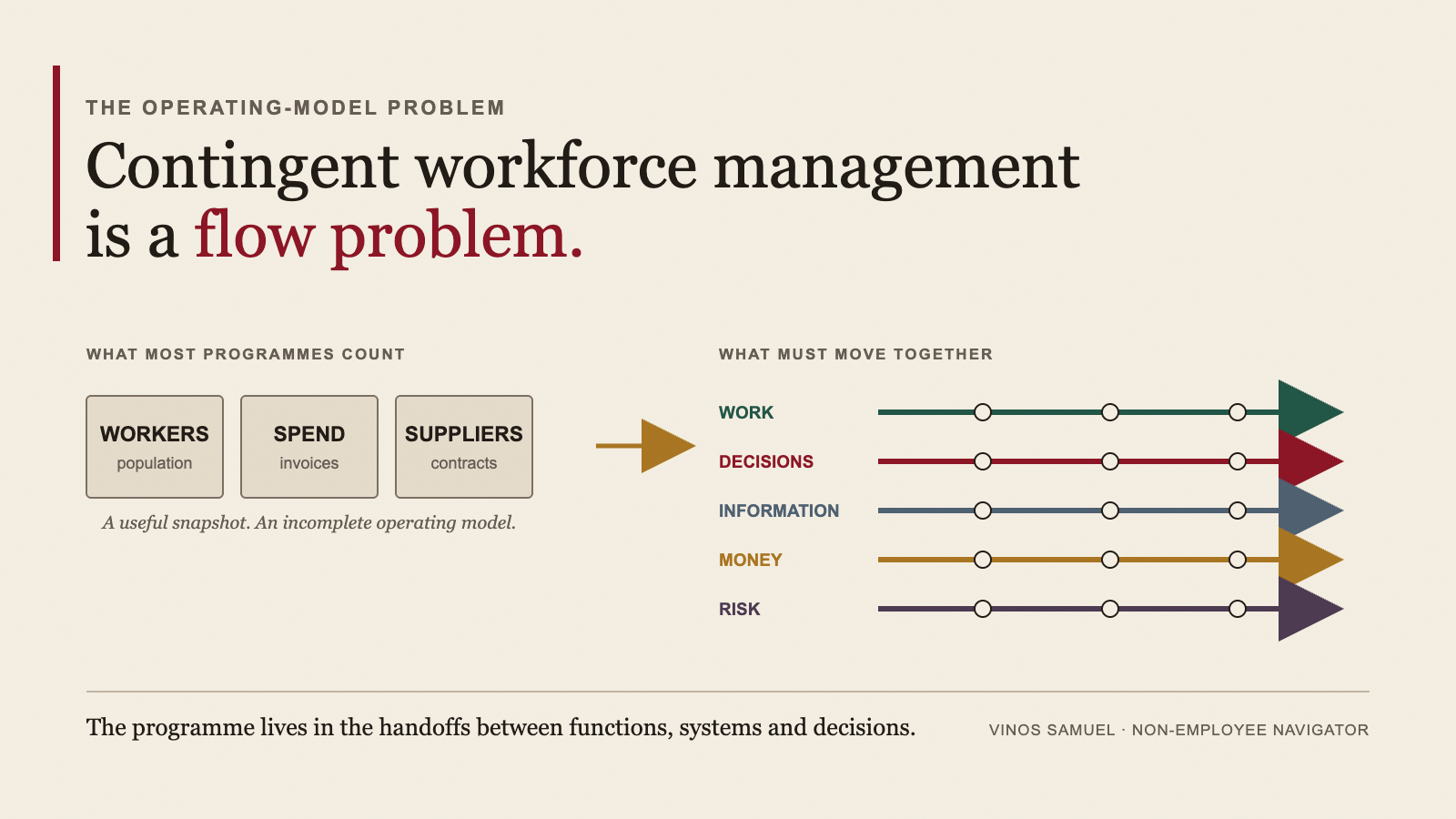
Stocks show what is in a workforce programme. Flows show how business need becomes cost, risk, delivery and learning.
In the previous article, I argued that the MSP of the future will manage exceptions rather than transactions.
That raises a more basic question. What is the system, agent or programme team moving?
Most contingent workforce dashboards show workers, suppliers, requisitions, SOWs and spend. These are useful measures. But they describe the programme at a particular moment.
Systems thinking gives us two useful terms for understanding the difference: stock and flow.
What are stocks and flows?
A stock is something that has accumulated.
The standard systems-thinking example is a bathtub. The amount of water in the bathtub is the stock. Water entering through the tap and leaving through the drain are the flows.
The water level tells you the current state. It does not explain why the level is rising, how quickly it is changing or whether the drain can keep up.
In a contingent workforce programme, stocks include:
- Active workers
- Approved suppliers
- Open requisitions
- Active SOWs
- Committed spend
- Spend accumulated to date
Flows change those stocks.
Worker starts increase the active-worker population. Exits reduce it. New requisitions enter the system. Filled and cancelled requisitions leave it. New suppliers are approved. Others are removed. Invoices add to accumulated spend.
But a workforce programme contains more than movements in and out of a population. Information, decisions, money, risk and evidence also move through the system. Those flows determine whether the population produces value.
What the dashboard sees and what the programme must manage
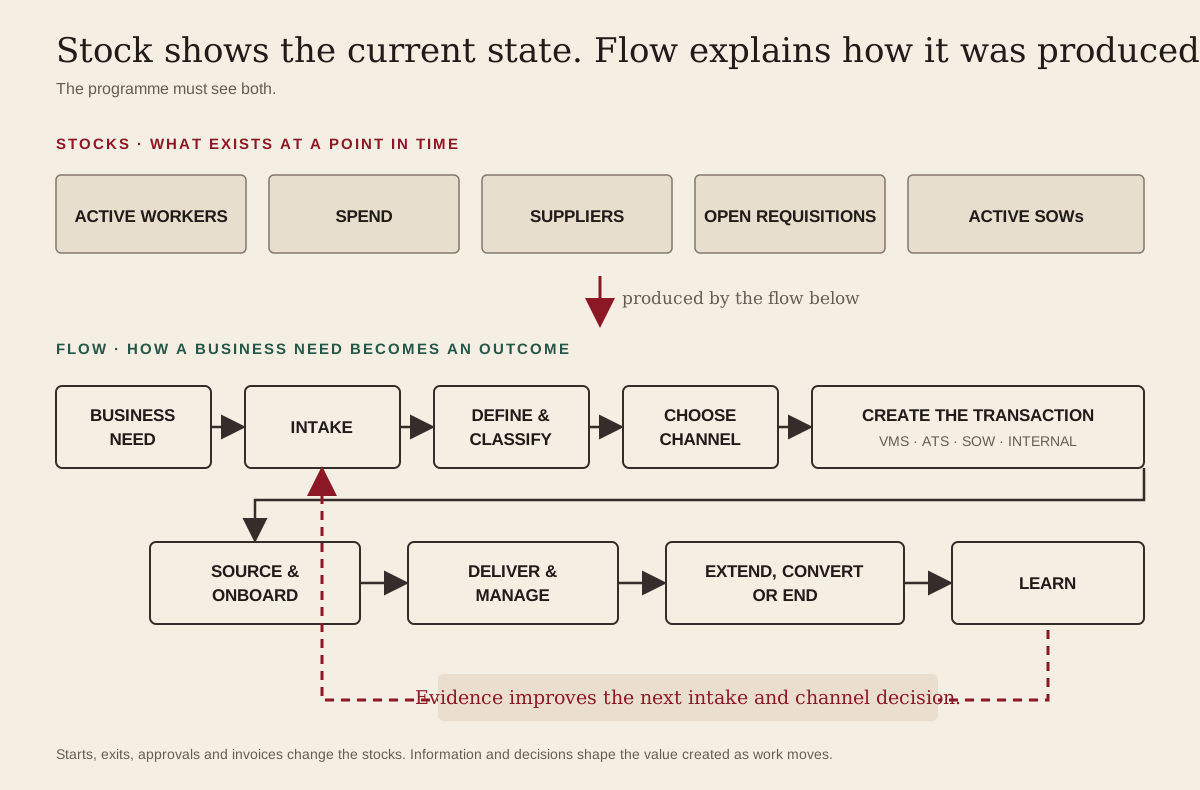
The stocks are produced by the flow below them.
A programme can report every stock accurately and still have a poor flow.
The programme usually begins with intake
An in-house contingent workforce programme normally begins when a manager submits an intake request.
The manager or programme team then creates the requisition in the VMS. In another channel, the same need might create an ATS requisition, an SOW intake or an internal-mobility request.
The existence of an intake process does not tell us how much the programme influences the decision.
In some organisations, intake is channel-neutral. The programme helps the manager define the work, tests possible workforce channels and then creates the correct transaction.
In others, the manager arrives asking for a contractor. Intake collects the information required to create a contingent requisition. The channel decision has already been made.
Both programmes have an intake process. Only one uses intake to shape the workforce decision.
That difference affects everything downstream.
The first stages have the most leverage
When the business need first appears, the purpose of the work is still visible.
What outcome is required? How long will the need exist? Is the work ongoing or temporary? Does it require supervision or a defined deliverable? Is the capability available internally? Could the work be redesigned or automated?
These questions cost little to answer. Their consequences can last for years.
Once the programme selects a channel, the cost structure and many of the risks begin to take shape.
An employee requisition, agency contractor, independent specialist and SOW each create different commercial terms, controls, management responsibilities and data. A poor channel decision cannot always be repaired through better sourcing.
A programme may negotiate an excellent rate for work that should have been bought differently.
The requisition converts the decision into a transaction
After intake and channel selection, the manager or programme team creates the transaction.
For contingent hiring, this usually means a VMS requisition containing the role, location, duration, rate, budget, skills, supplier route and approval requirements.
The requisition matters because it turns an interpretation of the work into something the system can process.
If the work was defined poorly, the weakness now moves forward.
Suppliers receive an unclear specification. Candidates are assessed against uncertain requirements. Rates are compared without a reliable view of the capability required. The programme may improve the wording, but it is working with a decision that has already hardened.
Processing the requisition faster improves throughput. It does not necessarily improve the workforce outcome.
Most programme attention sits in the middle of the flow
Contingent workforce programmes have become good at managing the middle:
- Requisition approval
- Supplier distribution
- Candidate submissions
- Rate-card compliance
- Screening and onboarding
- Time and invoice administration
- Assignment changes
- Operational reporting
This work creates control and consistency. It should not be dismissed.
But much of the programme’s attention sits after the work and channel have been selected.
Time-to-submit and time-to-fill can show how quickly the transaction moved. They cannot show whether the organisation selected the right transaction.
A fast flow through the wrong channel is still the wrong flow.
Delivery is where most of the money leaves
The organisation starts paying when the engagement begins.
It may take weeks before the worker becomes productive. They need access, context, relationships and an understanding of the organisation. The rate begins on day one. Full value may not.
Once the worker is productive, most programmes have less visibility into the work itself.
Is the engagement producing the intended outcome? Has the scope changed? Is the worker being used for the capability they were hired for? Has a temporary requirement become permanent? Is a supplier delivering an outcome or providing named labour under an SOW?
The programme can see the assignment and invoice. It may not see the value being created between them.
That is the difference between managing the stock and managing the flow.
Extension should restart the decision
An approaching end date should trigger a new workforce decision.
Does the work still exist? Has its nature changed? Should the worker extend, convert or leave? Does the rate still reflect the market? Has tenure created risk? Would replacement destroy capability the organisation has spent months developing?
Too often, extension becomes the absence of a decision.
The manager still needs the worker. The budget remains available. The VMS sends a reminder. The assignment continues.
The stock increases in tenure and spend, but the original assumptions are not tested again.
A flow-based programme treats extension as a control point. It reconnects the current engagement to the business need.
Most programmes have reporting but no return flow
A complete flow does not end with an exit.
The programme should learn:
- Which channel produced the best outcome?
- Which specifications created unnecessary rework?
- Which suppliers produced workers who became productive faster?
- Which rates reflected real scarcity?
- Which engagements repeatedly extended?
- Which SOWs behaved like staff augmentation?
- Which controls found genuine risk?
- Which exit failures left access or knowledge behind?
That evidence should return to intake, work definition and channel selection.
In many programmes, it does not.
Reports are produced. Dashboards are reviewed. Supplier scorecards are discussed. The next manager request then follows the same decision path as the previous one.
Reporting exists. Feedback does not.
In systems thinking, the loop remains open. Activity moves forward, but evidence from the outcome does not improve the next input.
The programme can become more efficient while repeating the same design mistakes.
Managing flow changes the role of CWS
A flow-based contingent workforce programme still manages workers, suppliers, rates, compliance and transactions.
It also asks how the business need moves through the complete system.
Where does the programme first influence the decision? Which stages can still change the outcome? Where does information stop moving? When does cost begin to accumulate? Which extensions occur without review? What evidence returns to the next intake?
This does not require the CWS team to own every stage.
It requires the programme to understand the full flow, define its intervention points and make the handoffs visible.
That is also the foundation required for meaningful automation. An agent can collect intake information, create a requisition, monitor an assignment or prepare an extension. But automating one step does not repair a flow that nobody has designed from end to end.
Trace one engagement
Choose one completed engagement and trace it from the first statement of need to its final outcome.
At each stage, ask:
- What entered this stage?
- What decision was made?
- What information was available?
- What moved to the next stage?
- What time, cost or risk accumulated?
- What evidence returned to improve the next engagement?
The exercise will show where the programme creates value, where it moves transactions and where the organisation loses the connection between work and outcome.
The question for the leadership team: Can we trace a business need through intake, channel selection, delivery and learning, or can we only report the workers and spend that accumulated along the way?
I’m Vinos Samuel. I help APAC leaders in HR, Procurement and Finance redesign contingent workforce programmes that have outgrown their operating model. If your dashboards show the population but not how work becomes value, send me a note on LinkedIn.