AI Agents at Intake & Routing of Work: Where Enterprise AI Actually Starts to Matter
In most enterprises, intake is treated as an administrative step. A request form. An email to HR. A Slack message to procurement. But intake is not admin. It's a decision bottleneck.
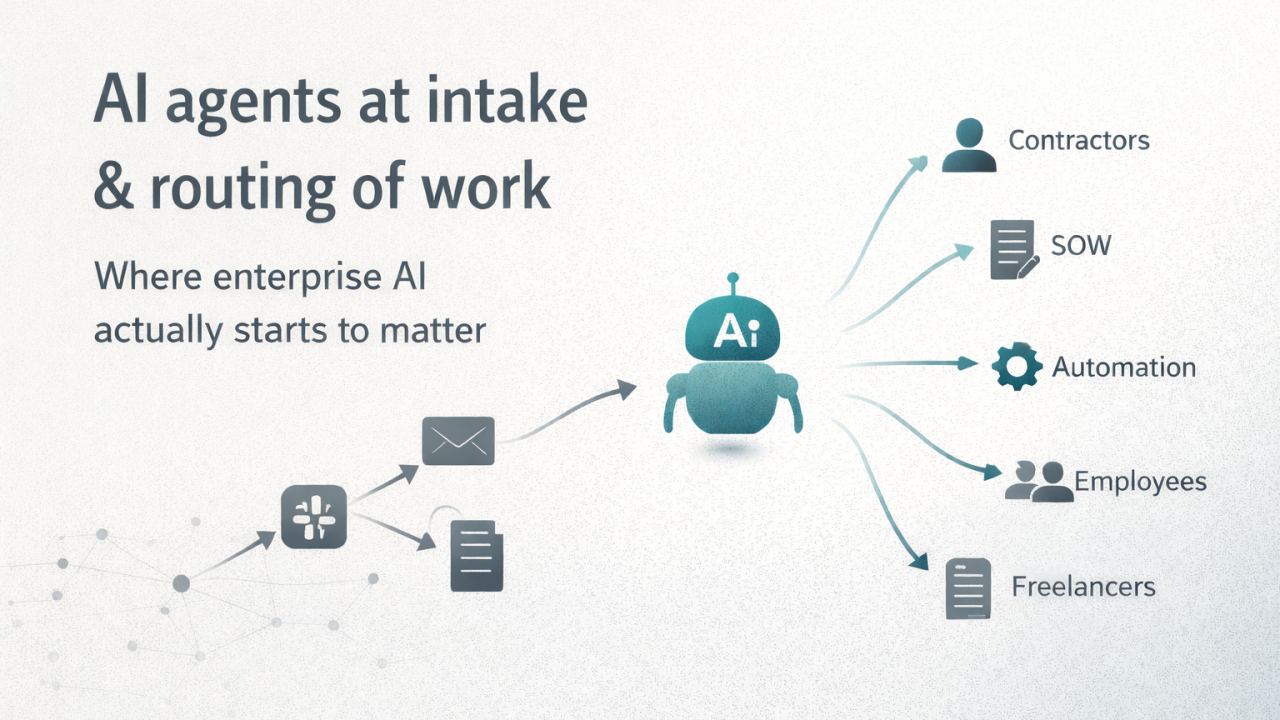
Most organizations meet AI far too late.
They introduce it after work has already been defined, budgeted, and approved. At execution. By then, the most important decisions are already locked in. What role is this? What hiring channel should it go through? Is this work best done by an employee, a contractor, a vendor, or not a human at all?
Those questions get answered informally, under pressure, by managers trying to move fast. AI arrives later to help write a job description or summarise notes. Useful, but marginal.
The real leverage point is earlier.
It's intake and routing – the moment work first enters the system.
The Quiet Failure Point Most Companies Ignore
In most enterprises, intake is treated as an administrative step. A request form. An email to HR. A Slack message to procurement.
But intake is not admin. It's a decision bottleneck.
This is where urgency overrides design and precedent quietly becomes policy. This is where ambiguity compounds into cost and risk.
By the time legal or finance gets involved, the engagement is already live. The system is reacting, not deciding.
This isn't a people problem. It's a systems problem.
Why Intake and Routing Matter More Than Execution
Execution problems are visible. Intake problems are silent.
A misrouted piece of work might still get done. The project will ship and no one will complain. But underneath, you've created:
A contractor doing employee-like work
A vendor engagement that should have been time-based
A manual hire where automation or AI would have sufficed
Individually, these look like small compromises. At scale, they define your operating model.
Routing is where organizations leak value – slowly and invisibly.
What AI Agents Are Actually Good At
AI agents are not good at vague strategy. They are very good at structured questioning and pattern recognition.
At intake, an AI agent doesn't need to "decide" for you. It needs to force clarity before commitment.
- ▹Ask the same critical questions every time
- ▹Map answers against policy, precedent, and risk thresholds
- ▹Surface edge cases early, when they're cheap to fix
- ▹Route work into the correct engagement path instantly
This isn't automation replacing judgment. It's judgment being applied consistently.
From Human Gatekeepers to Decision Design
Most organizations try to solve intake problems with people, which means more approvals and more escalation points. And that means more committees.
That doesn't scale, it just redistributes friction.
AI agents can change the model.
Humans design the logic. Agents apply it relentlessly. Only exceptions come back to people.
This could also be how AI earns trust – by being boring, consistent, and predictable.
A Practical Way to Think About Intake Logic
At its simplest, intake is about classification.
Is this work:
Outcome-based or time-based?
Short-term or ongoing?
Skill-scarce internally or easily sourced?
Local or cross-border?
Low or high compliance exposure?
Most managers answer these questions implicitly, based on habit, and almost always move towards FTE.
AI agents make those assumptions explicit.
Decision trees are a useful starting point. Not because they're sophisticated, but because they force discipline.
Why This Matters More in APAC
APAC exposes weak intake systems faster than most regions.
Different labor laws. Different enforcement realities. Different vendor maturity. Different cultural approaches to risk.
A single global policy does not survive contact with India, Singapore, Indonesia, and the Philippines simultaneously.
AI-led intake systems help by:
Embedding country nuance into routing logic
Reducing reliance on tribal knowledge
Making governance portable, not person-dependent
This isn't about control. It's about resilience.
When key decisions live only in people's heads, scale becomes fragile.
Common Objections—and What They Miss
What Good Intake Systems Actually Deliver
High‑performing intake and routing systems don't deliver dashboards.
They deliver:
Fewer grey-area engagements
Fewer downstream escalations
Faster hiring with less rework
Cleaner audits
Leaders who trust the system enough to use it
Most importantly, they reduce the number of bad decisions made quickly. That's the real enemy.
Final Thought
If AI only shows up after work has already been defined, you're missing the point.
The real opportunity is upstream, at the moment intent becomes action. Design that moment well, and everything downstream improves. Ignore it, and no amount of automation will save you later.
AI doesn't change execution first. It changes how decisions enter the system.
That's where the work really begins.