Your contingent workforce program has no nervous system
In some organisations, the CW team or MSP genuinely owns lifecycle governance. There's a dedicated function, a defined operating model, vendor oversight, and someone accountable for what happens between onboarding and exit. The problem there isn't that governance doesn't exist. It's that maintaining it is manual, slow, and expensive in team hours.
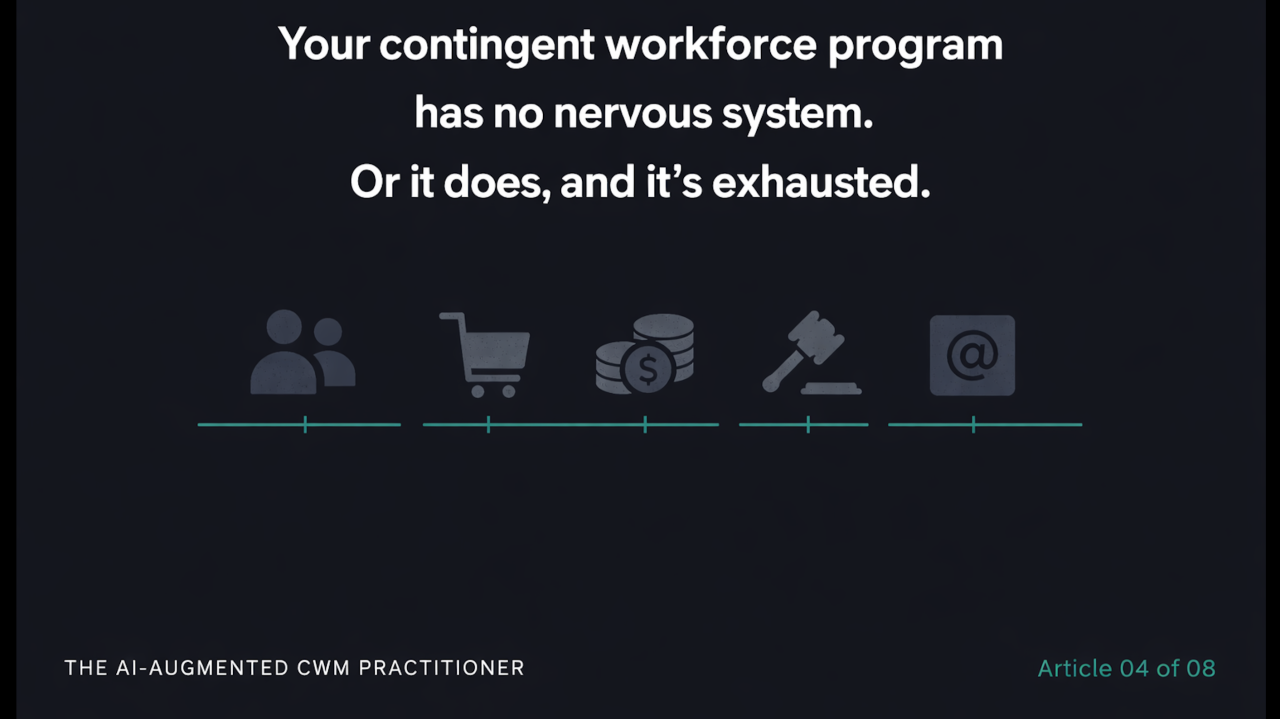
Your contingent workforce program has no nervous system. Or it does, and it's exhausted.
If you run a contingent workforce program, you already know the problem I'm about to describe.
You sit in the middle of five functions. HR, Procurement, Finance, Legal, IT. Each holds a fragment of the picture. You are the one who manually assembles those fragments when a decision needs to be made, when an audit asks a question, when a manager escalates something that should have been caught three months ago. You know which engagements are drifting. You know which renewals are going to land on your desk with two days' notice. You know the ones where the original SOW and the actual working arrangement stopped resembling each other somewhere around month four.
You built that knowledge manually. Relationship by relationship, system by system. And if you're honest, for most of your roster, the picture isn't fully current. Not because you're not doing your job. Because the volume and the fragmentation make a real-time, complete view structurally impossible without the tooling most programs don't have.
That's the problem AI can actually help with.
Two types of programs. Two different problems.
In some organisations, the CW team or MSP genuinely owns lifecycle governance. There's a dedicated function, a defined operating model, vendor oversight, and someone accountable for what happens between onboarding and exit. The problem there isn't that governance doesn't exist. It's that maintaining it is manual, slow, and expensive in team hours.
In a lot of other organisations, particularly mid-market companies and GCCs scaling fast across APAC, that function either doesn't exist or is scoped too narrowly to cover the full picture. Staffing is managed. SOW and IC governance is not. The MSP, if there is one, was brought in to manage vendor relationships, not to own lifecycle compliance across the full non-employee population.
If your CW function exists: this is about leverage
The governance capability is there. What's missing is operational speed to apply it consistently across the full roster.
Here's what manual synthesis looks like in most programs. An engagement needs a renewal decision. Someone pulls the PO history from the procurement system, checks the VMS for the extension log, finds the original contract in a shared drive, checks for compliance flags, and tries to remember whether the manager on record has changed. That takes 40 minutes per engagement if the data is clean. Most programs have backlogs of these.
AI compresses that to minutes. The CW practitioner still makes the call. AI does the assembly work that currently consumes most of the time.
The practical setup: build a Claude Project loaded with your program context. Classification policy, SOW standards, jurisdiction rules for each market, renewal approval thresholds, vendor contracts. A few hours once. No engineering, no IT involvement.
Then on a weekly or fortnightly cadence, feed in current engagement records. PO history, extension log, timesheet approvals, contract amendments. Ask Claude to synthesise per engagement and surface: decisions due in the next 30 days, engagements where current reality appears to diverge from the original contract terms, flags suggesting a human review is needed before the next extension is processed.
The output is a prioritised action list. Your team works the list. The other 130 engagements get confirmed as stable.
If your CW function doesn't exist: this is about viability
A lot of organisations running $10 to 20M in contingent and SOW spend across APAC don't have dedicated program governance. It grew organically. Hiring managers direct the relationships. Procurement manages the vendors. Finance tracks the spend. Nobody owns the through-line.
AI doesn't replace the function. You still need a person with the mandate to make decisions when the synthesis surfaces a problem. What changes is the minimum viable team size and cost for that function to work.
A part-time or fractional CW operator with a properly configured AI tooling setup can govern a mid-market program that would previously have required a full team. AI removes the data assembly work that makes governance so time-intensive. The human capacity that exists gets applied to decisions and relationships rather than spreadsheet maintenance.
What the persistent layer looks like in practice
This is not a real-time automated system. It's a structured, repeatable process that uses AI to do synthesis work that used to require a person to manually pull five systems together. It runs on a cadence the team sets. The human reads the output and makes the calls.
It is persistent in the sense that the Claude Project retains your program context between sessions. Policies, standards, jurisdiction rules. You don't re-brief it each time. You feed in the current records, it applies the accumulated context, and it produces the current picture. That continuity is what makes it a governance layer rather than a one-off tool.
What it catches that the existing system misses
Scope drift. The original SOW described defined deliverables with milestone payments. The last four timesheet approvals used time-and-materials language in the notes. The contract says one thing. The engagement drifted toward another. No single system catches this because it requires reading the contract and the approval notes together.
Manager turnover. The manager who approved the original engagement left six months ago. Their replacement has been approving extensions without reading the original scope. The engagement continues on momentum. Nobody has asked whether the structure is still appropriate.
Silent exits. Contract end date passed. No billing in 90 days. No formal exit record, no IP assignment confirmation, no offboarding documentation. The contractor stopped working but the engagement is technically still open.
Multi-function inconsistency. Finance sees one cost centre. Procurement has a different entity on the PO. The engagement shifted between operating structures and the paperwork didn't keep up.
Individually, none of these is catastrophic. Across a 150-person contractor population, several exist right now in most programs. The question is whether you find them in a monthly review or in an audit.
The honest limitation
AI reads what is in the record. If the VMS data is incomplete, if extension history wasn't logged, if approvals happened verbally, the synthesis reflects those gaps. It won't invent information that isn't there.
What it does is make the gaps visible. An engagement with a start date and a current PO but no contract document gets flagged. A timesheet approver name that changed three months ago with no contract amendment gets surfaced. The AI can't tell you what happened. It tells you something looks incomplete and a human needs to find out.
This turns out to be a useful discipline. Gaps keep appearing in the action list and creating work. Teams close them, not because someone issued a policy, but because leaving them open causes repeated friction.