Risk Unraveled: Navigating APAC's Contingent Compliance Maze
The Asia-Pacific (APAC) region is the world's fastest-growing market for contingent workforces, driven by a need for agility and specialised skills. However, this growth is met with a fragmented and rapidly evolving regulatory landscape. For multi-country operations, managing compliance for non-employee or contingent talent is a high-stakes challenge.
Risk Unraveled: Navigating APAC's Contingent Compliance Maze
The Asia-Pacific (APAC) region is the world's fastest-growing market for contingent workforces, driven by a need for agility and specialised skills. However, this growth is met with a fragmented and rapidly evolving regulatory landscape.
For multi-country operations, managing compliance for non-employee or contingent talent - including independent contractors, freelancers, and agency workers is a high-stakes challenge. The penalties for misclassification, non-compliance with new social security mandates, and incorrect payroll processing are escalating across APAC.
Here is a practical guide to managing compliance risks, informed by the latest regulatory shifts across key APAC markets in the last 12-18 months.
The Red Alert: Escalating Misclassification Risks
The core challenge remains worker misclassification. Governments across APAC are intensifying scrutiny to ensure that workers who are treated like employees receive the corresponding statutory benefits.
China: Misclassified workers may be entitled to full employment benefits, and the Chinese government is increasing enforcement. The key test is generally the degree of control exercised by the hiring company.
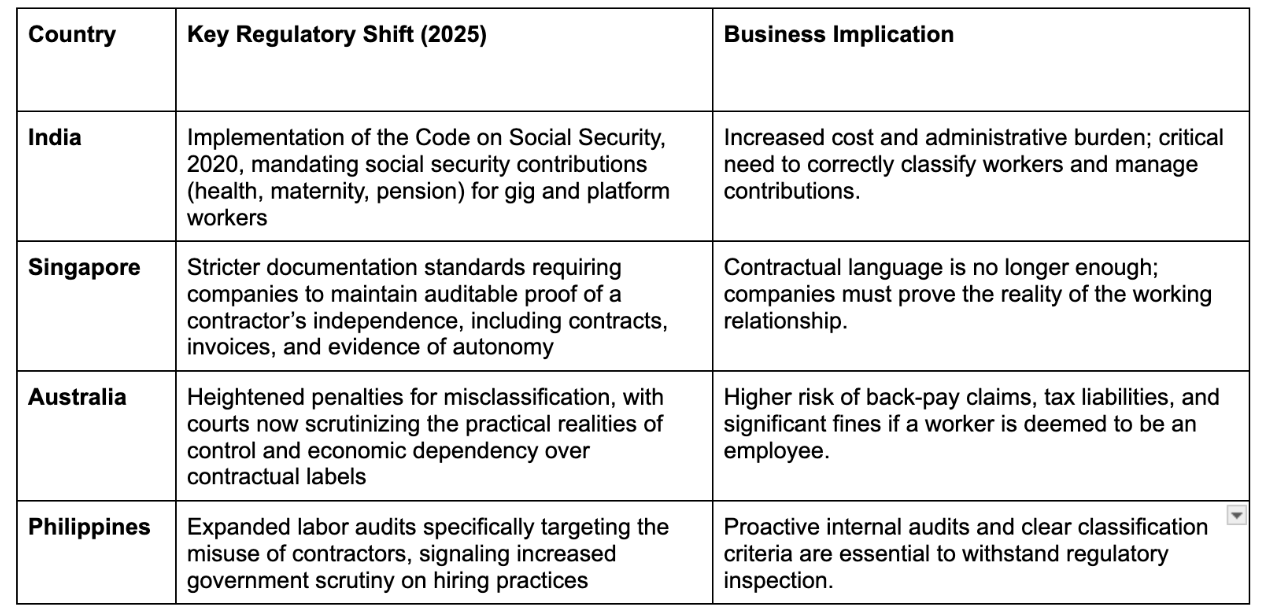
Australia: Landmark decisions, coupled with the introduction of new legislation (such as the 'Same Job, Same Pay' principle for labour hire workers), signal a tougher approach. The legal test is moving toward substance over form, focusing on the true economic reality of the relationship.
Philippines: The Department of Labour and Employment (DOLE) has updated inspection guidelines to increase scrutiny of contracting and subcontracting practices, focusing on whether the work is core to the business or if the contractors lack substantial capital/equipment.
The primary strategy here is a rigorous, country-specific compliance audit of every contingent role before onboarding. A role audit must address local legal tests for control, economic independence, and integration into the core business.
Key Regulatory Updates by Country (Last 12-18 Months)
Navigating a multi-country operation requires a granular understanding of local mandates. Here are critical updates in labour, payroll, and social security across the region:
India: Focus on Gig Worker Welfare
The anticipated full implementation of the Code on Social Security, 2020, marks a significant move to provide social protections to gig and platform workers.
Key Regulation: It mandates registration of gig workers on government portals and employer contributions towards health, maternity, and old-age benefits.
Impact on Payroll: Companies engaging gig workers must prepare for new mandatory contributions and reporting requirements for welfare schemes, a stark departure from traditional independent contractor models.
Singapore: Enhanced Documentation and Worker Protections
Singapore, traditionally a business-friendly hub, is tightening its framework for non-employee talent.
Key Regulation: New standards for contractor documentation and registration, especially for foreign and third-party contractors, are being tightened. Crucially, the Platform Workers Bill is being introduced to provide enhanced protections for platform workers in ride-hailing and delivery services.
Labour Law: The first Workplace Fairness Bill (passed Jan 2025) prohibits unfair employment decisions based on protected characteristics like nationality, age, and caregiving responsibilities. While aimed at employees, the principles often influence contractor management practices.
Vietnam & Thailand: Minimum Wage and Standardisation
Both countries have seen recent adjustments to mandatory compensation and standards.
Vietnam: Regional minimum wages have seen increases (effective from mid-2025), impacting agency and contract worker pay rates and requiring careful adjustment of payroll and contract budgets.
Thailand: The daily minimum wage saw an increase (Jan 2024), impacting the cost of engaging temporary workers across various sectors.
South Korea: Working Hours and Leave Flexibility
South Korea is relaxing its strict 52-hour workweek limits for certain sectors and extending parental leave entitlements, changes that can impact how long-term contingent staff and project-based roles are structured.
Japan: Tax and Social Security Implications
While primarily focusing on retirement age and tax changes, the sophisticated staffing market in Japan demands extreme caution regarding Permanent Establishment (PE) risk - the risk that a foreign company's long-term contractor creates a taxable presence.
Strategic Pillars for Multi-Country Compliance
To navigate this fragmented compliance landscape, organisations must move beyond a one-size-fits-all global policy and localise their approach.
1. Onboarding: Vetting and Validation
Localised Contracts: Use contracts that reflect the legal tests of the specific jurisdiction. For instance, clearly articulate the economic independence of an independent contractor in a way that stands up to an audit (e.g., they supply their own tools, bear financial risk, and can serve other clients).
Documentation Standards: Implement stringent and country-specific documentation requirements for foreign workers and third-party contractors, particularly in countries like Singapore and Australia.
2. Payroll and Tax: Mitigating Liability
Shadow Payroll: In many countries (e.g., China, Japan, South Korea), an independent contractor may trigger a tax withholding obligation for the engaging entity, even if they are paid gross. Companies must implement a shadow payroll mechanism to track local tax and social security liabilities.
Employer of Record (EOR) Services: Consider using an Employer of Record (EOR) to legally employ full-time contingent workers in markets where local entity setup or compliance is complex. This shifts the local labour and payroll compliance burden to the EOR provider, dramatically mitigating misclassification risk. Note: Clarification in Singapore suggests EORs cannot be used to employ foreign nationals as a primary means of entry, underscoring the need for diligence.
3. Labour Laws: Control and Integration
Core vs. Non-Core: Enforce a strict policy that contingent workers do not perform tasks that are core to the business for an extended period. In the Philippines, this is a major trigger for inspection.
Control Audit: Managers engaging contingent talent must be trained to limit the degree of control and supervision they exert. The worker should not be mandated office hours, equipment, or direct managerial oversight that mirrors an employee relationship.
Final Takeaway: Adopt an 'Audit-Ready' Posture
The common thread across APAC is an intensified focus on enforcement and worker welfare. Passive compliance is no longer tenable. Companies must adopt an 'audit-ready' posture by:
Centralising Regulatory Tracking: Use a single, real-time register to monitor labour law updates, local case law, and country risk scores across all operating markets.
Localising Policies: Translate global contingent workforce policies into country-specific playbooks that reflect the local legal tests for classification.
Leveraging Expertise: Engage local legal and payroll specialists (or a trusted EOR/compliance partner) to ensure contracts and onboarding processes are updated to meet the latest 2024/2025 compliance standards.
By treating contingent compliance as a strategic business priority, your organisation can unlock the agility of the APAC non-employee workforce while safely navigating the region's complex regulatory maze.