The FTE vs Contractor Question Deserves a Real Model. Not a Gut Feel.
Most FTE versus contractor conversations collapse all of this into a single question about hourly rate. That is why the decisions are often wrong and the reasoning rarely survives scrutiny.
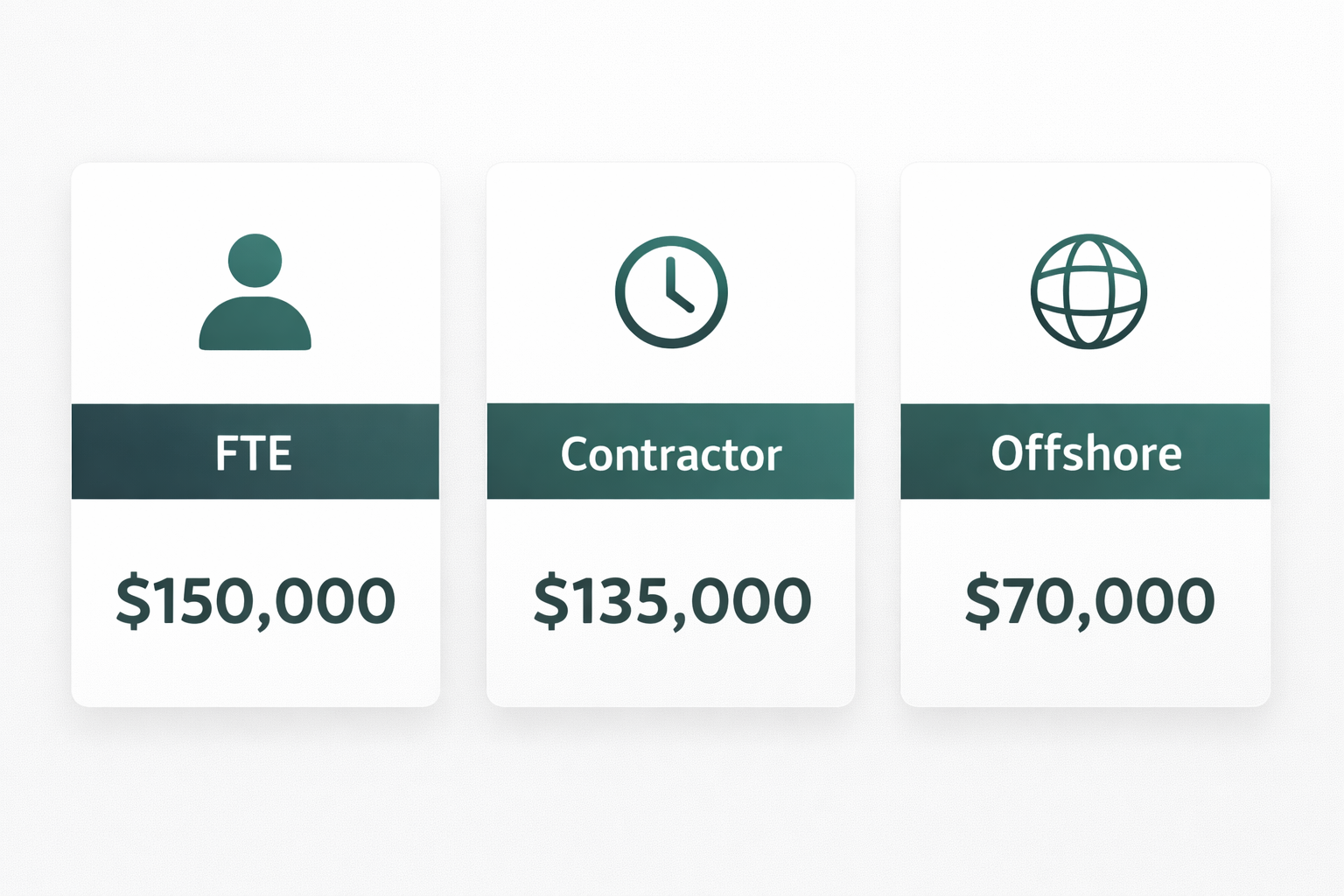
The FTE vs Contractor Question Deserves a Real Model. Not a Gut Feel.
The request lands in your inbox on a Tuesday morning.
A hiring manager needs three senior engineers. They need them in six weeks. They want to know: should we hire or contract?
You have thirty minutes before your next meeting. You know the answer depends on at least six variables. You also know that if you send back a model, Finance will ask where the numbers came from. If you send back an opinion, the hiring manager will ignore it and do what they were going to do anyway.
So most teams do what they have always done. They make a call based on experience and instinct, dress it up with some rough numbers, and move on.
The decision gets made. The reasoning behind it does not survive contact with the next quarter.
This is not a failure of expertise. It is a failure of infrastructure. The FTE versus contractor decision is one of the most consequential workforce choices a business makes — it affects cost, speed, flexibility, risk, and culture – and most organisations have no consistent model for making it.
AI does not make the decision for you. It builds the model in twenty minutes so the decision can actually be made well.
Why This Decision Is Harder Than It Looks
On the surface the comparison seems simple. Contractor costs more per hour. FTE costs less per hour but comes with overhead. Run the numbers, pick the cheaper option.
That framing misses most of what matters.
- Ramp time. An FTE hire in Singapore takes eight to twelve weeks from offer to productive. A contractor can be on-site in two. If the project starts in six weeks, the FTE option may not even be viable regardless of cost.
- Benefits loading. The FTE base salary is not the total cost. Add CPF contributions, insurance, leave entitlements, annual bonus, equity if applicable, and the fully-loaded cost is typically 25 to 40 percent above base depending on seniority and geography. Most hiring managers do not think in fully-loaded costs. Finance does.
- Duration and certainty. A contractor on a six-month engagement is a fundamentally different proposition from a contractor who has been renewing quarterly for two years. The longer the duration and the less defined the endpoint, the more the economics shift toward FTE — and the more the compliance risk increases.
- Severance and exit costs. Ending an FTE relationship in Singapore, India, or most of Southeast Asia carries notice periods, severance obligations, and sometimes legal complexity. A contractor engagement ends at the contract term. That optionality has real value in uncertain environments.
- The offshore SOW option. For roles where outcomes can be clearly defined and remote delivery works, a fixed-fee SOW with an offshore team is often a third option that nobody models because it requires more upfront scoping. It frequently wins on cost and sometimes on speed.
Most FTE versus contractor conversations collapse all of this into a single question about hourly rate. That is why the decisions are often wrong and the reasoning rarely survives scrutiny.
Start Here: Clarify the Channel Before You Model the Cost
Before running any cost comparison, there is a more fundamental question to answer: which engagement channels are even valid for this particular need?
The nature of the work, the level of direction involved, the expected duration, and the jurisdiction you are hiring in all affect which options are on the table. There is no point modelling a detailed FTE versus IC cost comparison if the nature of the work means a SOW is the only compliant option – or if the role clearly requires permanent employment and the contractor path creates unacceptable risk.
I built a simple Hiring Channel Decision Tree to help with exactly this step. It walks through the key variables – work type, duration, direction, compliance considerations – and outputs a recommended channel: direct FTE hire, agency temp, independent contractor, or SOW. It takes about two minutes and surfaces considerations that often get skipped in the rush to a headcount decision.
What AI Does Here
Once you know which channels are in play, you are asking your AI assistant to do the structured analytical work that precedes a good decision. Not to decide. To model.
Whether you are using Claude, Microsoft Copilot, a custom GPT your organisation has deployed, or another capable LLM – the approach is the same. You provide the variables. The AI runs three scenarios, shows the total cost of workforce for each, flags the non-cost factors that the numbers cannot capture, and gives you a recommendation with its reasoning visible.
The output is a brief you can share with Finance and the hiring manager in the same conversation. Everyone works from the same model. The discussion moves from opinion to assumption – which variables do we agree on, which do we want to stress-test, what is our actual risk tolerance here.
That is a qualitatively better conversation than the one most organisations are having.
The Practical Walkthrough
The variables you need
Before you open your AI tool, collect the inputs. You do not need precise numbers – directionally accurate is enough for a first-pass model.
- For the contractor option: bill rate per hour, expected weekly hours, engagement duration, any agency margin if applicable, onboarding time.
- For the FTE option: expected base salary, benefits loading percentage for that geography, ramp time to full productivity, expected tenure, severance exposure at exit.
- For the offshore SOW option if relevant: fixed project fee or monthly retainer, scoping cost, ramp time, any quality or coordination overhead you want to factor in.
What you ask your AI tool
Sample prompt for Claude, GPT‑4o, Gemini, or Copilot:
"I need to model three workforce options for a 12-month senior data engineering need in Singapore. Option A: two contractors at $120 per hour each, 40 hours per week. Option B: one FTE hire at $140,000 base salary with 32 percent benefits loading, 8 weeks ramp time to full productivity. Option C: offshore SOW engagement at $95,000 fixed fee for defined deliverables over 12 months. For each option calculate total cost over 12 months accounting for ramp time. Flag any non-cost factors I should consider. Output a comparison table and a recommendation with your reasoning."
What comes back
Option A – Two contractors. Total 12-month cost: $499,200. Available at full capacity from week one. No severance exposure. Co-employment risk increases beyond month 12 in Singapore.
Option B – One FTE. Total 12-month cost including benefits load: $207,480. Available at full capacity from week nine. Severance exposure at exit: approximately $26,900 at standard Singapore notice and gratuity. Note: one FTE versus two contractors is not a direct capability comparison – this option delivers roughly half the capacity.
Option C – Offshore SOW. Total 12-month cost: $95,000 fixed. Delivery depends on clearly defined scope and acceptance criteria. Coordination overhead not modelled. Highest risk if requirements change mid-engagement.
Recommendation: If the need is genuinely two senior engineers for 12 months with a defined endpoint, Option A is the most straightforward. If the need is ongoing and likely to extend, Option B should be modelled over 24 months where the FTE economics improve materially. Option C warrants serious consideration if the work can be scoped as a defined outcome rather than capacity.
That output takes an AI tool under two minutes to produce. It would take a senior ops lead the better part of a morning to build from scratch and even then the model would likely sit in a spreadsheet nobody else can interrogate.
Running This as a Repeatable Workflow
The one-off model is useful. Building a repeatable version is more valuable.
If your organisation makes FTE versus contractor decisions regularly – and most organisations above a thousand headcount do – the inputs are largely the same each time. Geography-specific benefits loading rates. Standard bill rate ranges by role family. Severance calculation logic by jurisdiction.
If you are using Claude, you can load all of this into a Claude Project as a reference document. Most enterprise AI tools have an equivalent – a persistent workspace, a system prompt, a knowledge base – where your organisation's standard assumptions live. Every subsequent headcount scenario starts from that foundation. The model becomes faster to run and more consistent across the team. Different people are not using different benefits loading assumptions, different severance estimates, different ramp time proxies.
Over time the workspace accumulates the decisions you have made and the reasoning behind them. That institutional memory has its own value – particularly when a new team member needs to understand why certain decisions were made a year ago.
What to Do With the Model
The model is not the answer. It is the starting point for the right conversation.
Take it to the hiring manager and Finance together. Walk through the assumptions. The conversation will surface the things the model cannot capture — the team's preference for someone in the office, the specific technical depth required, the organisation's current risk appetite for headcount.
Those factors belong in the decision. They just should not be the whole decision. The model ensures the financial and compliance logic is visible before the cultural and operational preferences take over.
When you arrive with a model, the conversation changes in a specific way. People stop arguing about the conclusion and start arguing about the assumptions. That is a more honest and productive argument. It produces better decisions — and decisions that people own rather than decisions that get relitigated the following quarter.
The Honest Caveat
Total cost of workforce is one dimension of this decision. It is an important one. It is not the only one.
A model that says the contractor option costs $300,000 more over 12 months is not necessarily a model that says hire the FTE. If the project is uncertain, if the organisation is in a cost-reduction cycle, if the role requires skills that are transitional rather than permanent – the flexibility premium of the contractor option has real value that does not show up in the cost comparison.
The AI model makes the financial logic transparent. It does not reduce a complex decision to a number. The judgment layer still belongs to the practitioner. That is not a limitation of the tool – it is the correct division of labour.
What This Means for the CWM Function
The FTE versus contractor question sits at the intersection of TA, Finance, and contingent workforce. Historically it has been answered by whoever had the strongest opinion in the room.
The CWM function that shows up with a model – transparent assumptions, scenario comparison, flagged risks – is the function that earns the right to be in that room consistently. Not because the model is always right. Because it structures the conversation in a way that produces better outcomes than opinion alone.
That is what moving from transactional to strategic actually looks like in practice. Not a reorganisation or a new job title. A model that makes the decision better.