The Ticking Time Bomb in Your Workforce: Are You Ready for the Contingent Worker Revolution?
Your organization is likely already part of a seismic shift happening across India, Southeast Asia and beyond. To gain agility and access specialized skills, you're hiring more contractors, freelancers, and gig workers. But is your approach a strategic advantage or a ticking compliance time bomb?
The Ticking Time Bomb in Your Workforce: Are You Ready for the Contingent Worker Revolution?
Your organization is likely already part of a seismic shift happening across India, Southeast Asia and beyond. To gain agility and access specialized skills, you're hiring more contractors, freelancers, and gig workers. You're in good company - tech giants like ByteDance, Grab, and Shopee are doing the same. But here's the uncomfortable question: is your approach a strategic advantage or a ticking compliance time bomb?
Recent data shows that the contingent workforce is no longer a fringe trend; it is a core pillar of modern business strategy. The Asia-Pacific (APAC) market for temporary staffing is valued at a staggering $120 billion and is the fastest-growing in the world. In India alone, the gig economy is projected to triple in the next five years, with an estimated 2 million new contract roles expected in 2026. Companies are embracing this model not just for cost savings, but for the critical agility it provides in a volatile market - a recent Everest Group survey found that 80% of organizations plan to expand their contingent workforce in the next 18 months.
However, this rapid expansion brings immense complexity. While many companies are hiring contingent workers, few are managing them strategically. This is where the risk lies. A reactive, ad-hoc approach to engaging non-permanent workers exposes your business to significant compliance penalties, operational inefficiencies, and an inability to scale effectively.
Consider the case of ByteDance. The company is reportedly managing a global contingent workforce of nearly 100,000 individuals. Crucially, they are not treating this as a series of one-off hires. Instead, they have established dedicated leadership roles and a formal program to oversee this vital talent pool, focusing on policy, systems, and governance. This represents a mature, strategic approach that stands in stark contrast to the fragmented methods common in the market.
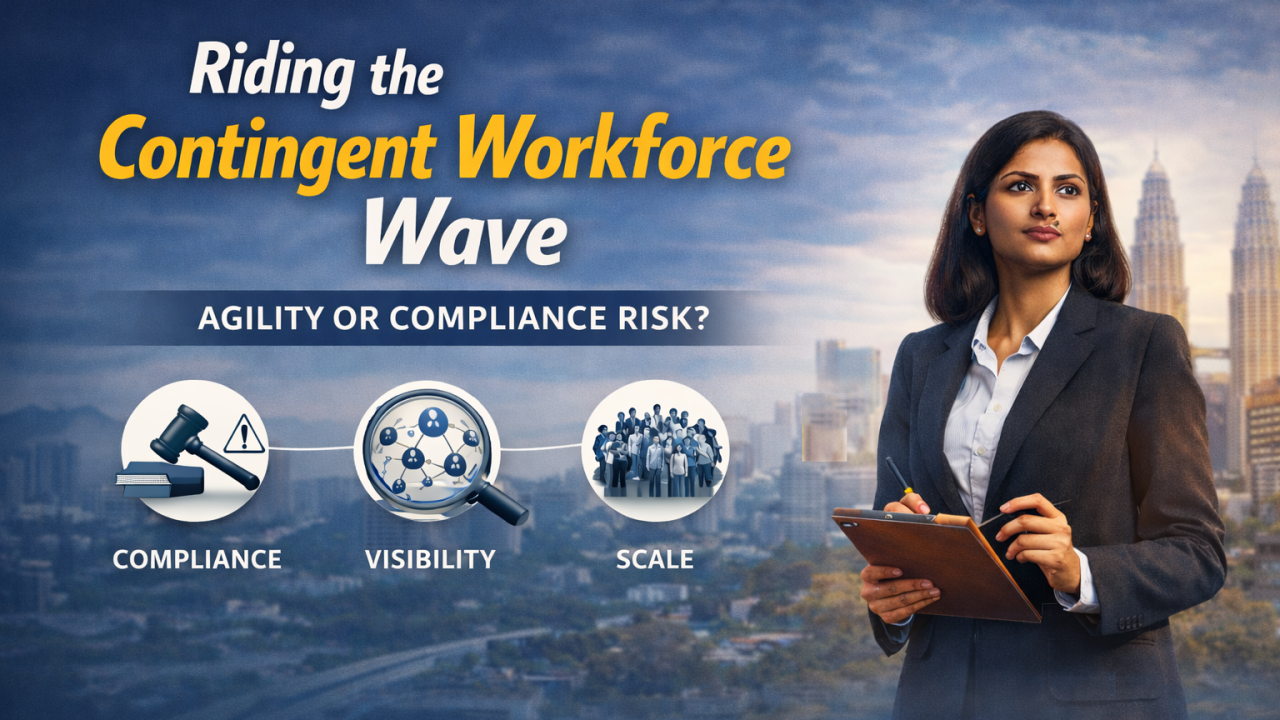
For decision-makers in India and SEA, the lesson is clear: it is time to move beyond ad-hoc hiring and build a robust contingent workforce program. Success hinges on mastering three critical pillars: Compliance, Visibility, and Scale.
The Compliance Minefield: A Region of 20+ Legal Frameworks
The regulatory landscape for contingent workers in APAC is a fragmented and perilous maze. With over 20 distinct legal frameworks, what is standard practice in one country can be a major violation in another. Governments are cracking down on misclassification and strengthening worker protections, raising the stakes for non-compliance.
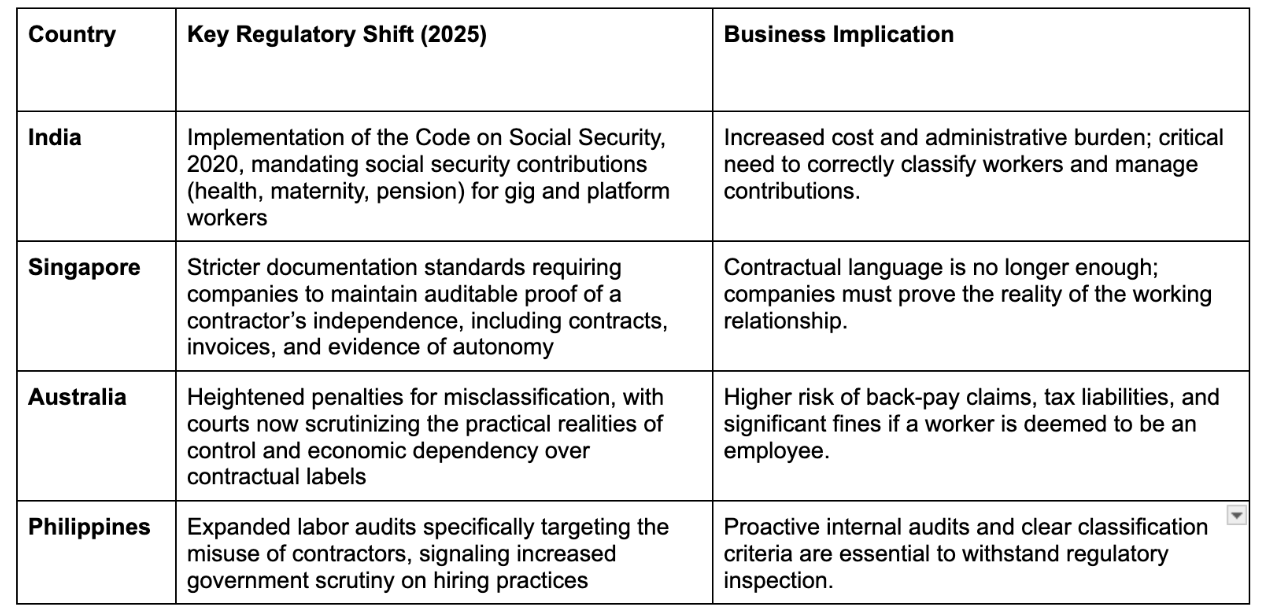
Key Regulatory Shifts (2025):
India: Implementation of the Code on Social Security, 2020, mandating social security contributions (health, maternity, pension) for gig and platform workers. Business Implication: Increased cost and administrative burden; critical need to correctly classify workers and manage contributions.
Singapore: Stricter documentation standards requiring companies to maintain auditable proof of a contractor's independence, including contracts, invoices, and evidence of autonomy. Business Implication: Contractual language is no longer enough; companies must prove the reality of the working relationship.
Australia: Heightened penalties for misclassification, with courts now scrutinizing the practical realities of control and economic dependency over contractual labels. Business Implication: Higher risk of back-pay claims, tax liabilities, and significant fines if a worker is deemed to be an employee.
Philippines: Expanded labor audits specifically targeting the misuse of contractors, signaling increased government scrutiny on hiring practices. Business Implication: Proactive internal audits and clear classification criteria are essential to withstand regulatory inspection.
The Visibility Imperative: You Can't Manage What You Can't See
As your contingent workforce grows, do you have a single source of truth for who these workers are, what they are doing, where they are located, and how much they are costing you? For most organizations, the answer is a resounding no. This lack of visibility makes it impossible to manage performance, control spending, or assess risk.
The market is already responding to this challenge. The global Managed Service Provider (MSP) market, which helps organizations manage contingent labor, has grown to $226 billion, and spend on Statement of Work (SOW) projects now accounts for 39% of all MSP spend - up from just 18% in 2017. This signals a critical shift from hiring for roles to procuring for specific outcomes and skills. Without a centralized system to track these engagements, you are flying blind.
The Challenge of Scale: From 50 to 5,000
The manual processes and informal agreements that work for a handful of contractors will inevitably break down as your contingent workforce scales into the hundreds or thousands. Onboarding, payments, performance tracking, and offboarding become logistical nightmares, consuming valuable resources and creating compliance gaps.
Scaling a contingent workforce program requires a deliberate investment in technology, standardized processes, and clear governance. It requires building a program that is both efficient and auditable, capable of supporting the dynamic needs of the business without introducing unacceptable risk.
The Strategic Inflection Point is Now
The question is no longer if you will rely more heavily on a contingent workforce, but how you will manage this critical talent segment. Continuing with a reactive, decentralized approach is a path fraught with peril.
Building a future-ready contingent workforce program - one that provides visibility, ensures compliance, and is built to scale is one of the most important strategic undertakings for any growing business in India and Southeast Asia today. The time to act is now.
What is your organization doing to prepare for the contingent worker revolution?